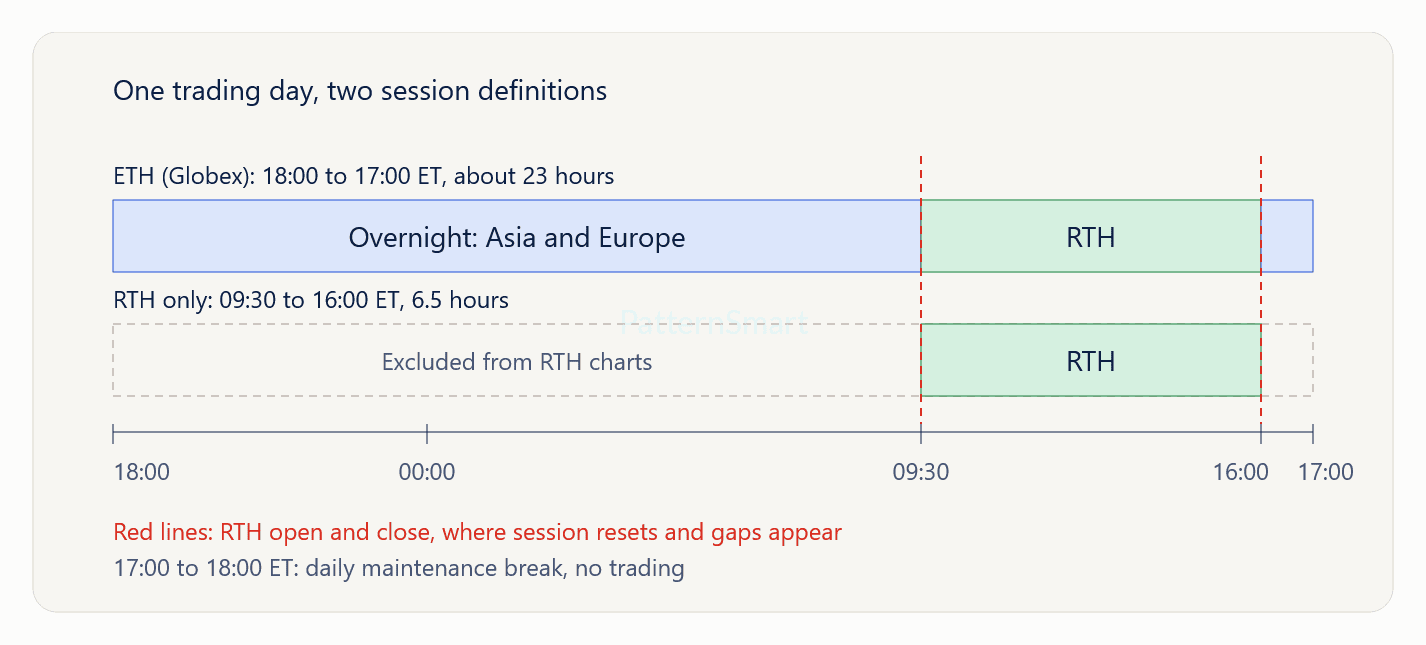
Roughly 17 of the 23 ETH hours fall outside RTH. Overnight trading is usually thinner, and it reacts to Asian and European news, economic releases, and geopolitical headlines. Many “daily” indicators silently assume one of these two worlds.
Why session choice changes indicator calculations
Any indicator that resets, anchors, or accumulates across a “day” depends on the session definition. A few examples:
| Indicator or statistic | What changes between RTH and ETH |
|---|---|
| Session VWAP | Anchor time and the volume it accumulates. ETH VWAP includes thin overnight prints and starts at 18:00 ET. |
| Volume profile, POC, value area | Overnight volume can shift the point of control and widen or narrow the value area. |
| Daily high and low | The ETH high may be set at 03:00 ET, long before the cash open. |
| Opening range | Defined from 09:30 in RTH mode, but ambiguous in an ETH chart unless you pick an anchor. |
| Previous close and gap | RTH close at 16:00 differs from the ETH settlement-time price. |
| ATR and range-based bands | Overnight bars contribute small ranges, which drags averages down. |
| Cumulative delta, TWAP | Accumulation windows begin and end at different times. |
| Moving averages and RSI | Bar-count lookbacks span different amounts of real time depending on how many bars each session produces. |
The last row is the quiet one. A 20-bar moving average on a 5-minute chart covers 100 minutes in either mode. But when the chart is filtered to RTH, those 20 bars may reach back across the previous day’s close, so the average blends yesterday’s afternoon with today’s morning. In ETH mode the same average blends the overnight session into the open. Both are technically correct, and they tell different stories.
Overnight gaps and session resets
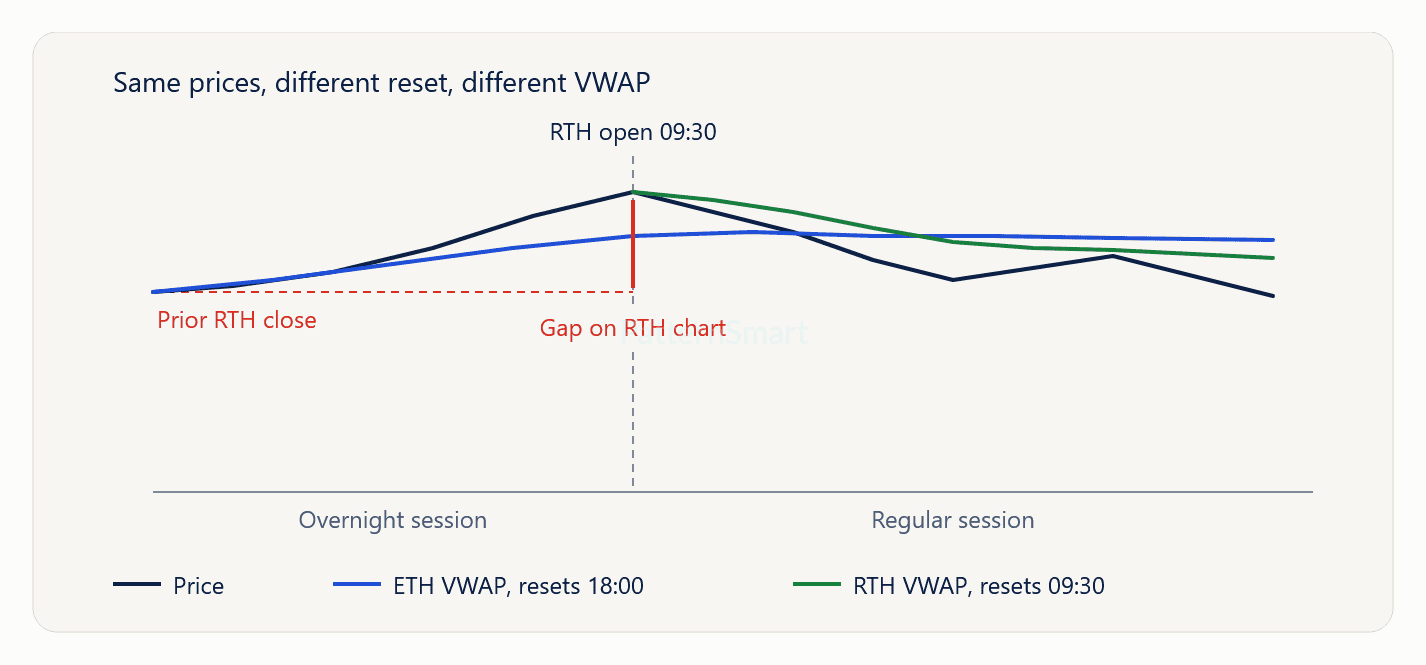
The most visible symptom is the gap. On an RTH-only chart, a gap is the distance between the 16:00 close and the next 09:30 open. On an ETH chart the market traded continuously in between, so the “gap” is just overnight price action. The same event shows up as one big candle gap on one chart and as a smooth move on the other.
The drawing below shows how one price path produces two different VWAPs when the reset time differs.
Daylight saving transitions
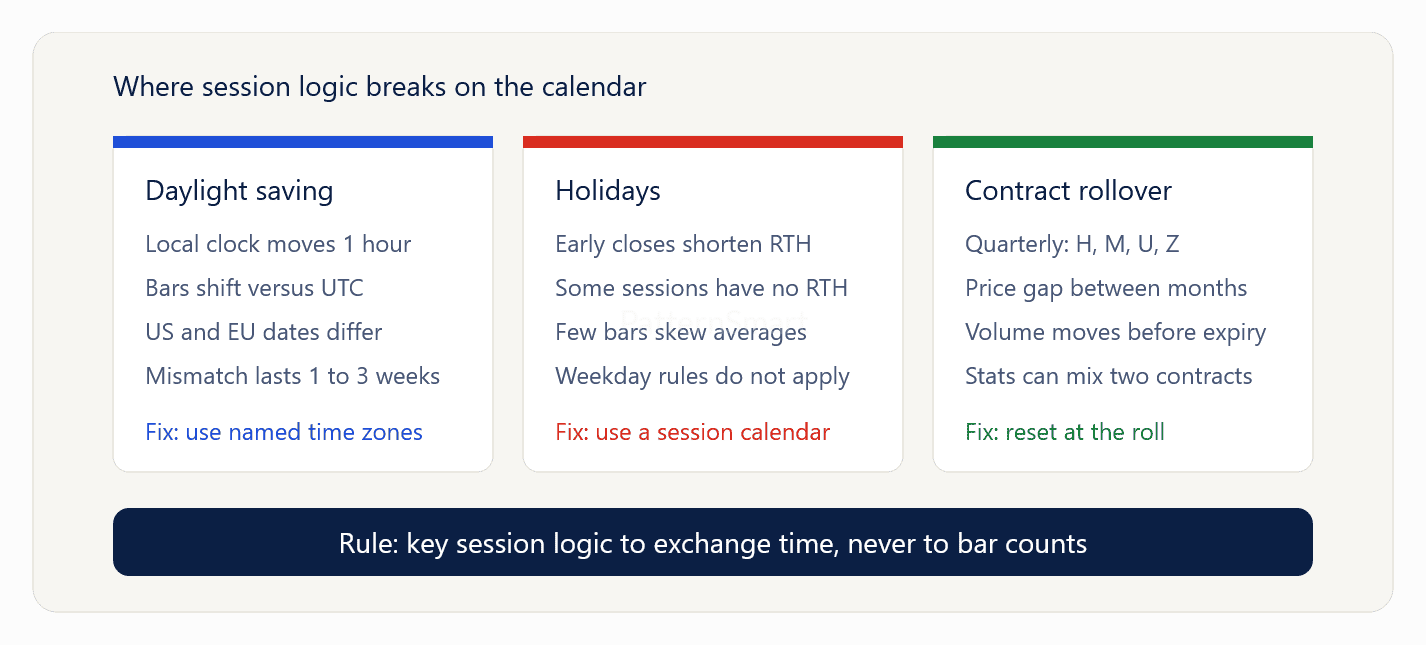
CME session times are defined in exchange local time and follow US daylight saving rules. If your platform stores timestamps in UTC or in a fixed offset, the RTH window moves by an hour in UTC twice a year. A filter hardcoded as “14:30 to 21:00 UTC” is correct in summer and wrong in winter.
There is a second layer for traders who work across regions. The US switches clocks on the second Sunday of March and the first Sunday of November. Europe switches on the last Sunday of March and the last Sunday of October. For a few weeks each spring, and one week each autumn, the gap between New York and London differs from its usual value. European session overlays, “London open” markers, and any indicator that blends US and European hours will drift unless they use named time zones such as America/New_York and Europe/London.
Transition days also have irregular lengths. The day the clocks change, the overnight session contains one hour more or less than normal, and per-session statistics like total volume or bar count cannot be compared directly to a normal day.
Holidays and shortened sessions
Holiday handling is where simple weekday-and-clock filters fail. On some holidays the cash market is closed, but futures still trade on a modified schedule. On others, such as the day after US Thanksgiving, the cash market closes early and futures follow a shortened schedule. A fixed 09:30 to 16:00 filter will either capture nothing or capture hours that are not really regular trading.
The practical effects:
- Missing RTH: an RTH-filtered chart may have no bars at all for that date, so “previous day” logic must skip to the last valid session instead of assuming yesterday.
- Short RTH: averages, opening ranges, and volume comparisons look abnormal because the session has fewer bars and thinner volume.
- Thin liquidity: range-based signals trigger more often on holiday sessions because moves happen on lower volume.
Always confirm modified hours against the CME holiday calendar. They change from year to year, and with Thanksgiving week and the December holidays ahead, this is the time of year when these bugs surface.
Contract rollover
Equity index futures expire quarterly, in March, June, September, and December (codes H, M, U, Z). Liquidity typically migrates to the next contract roughly one to two weeks before expiration. For the December 2026 contract, which expires on December 18, traders will be moving to the March contract in the days before that.
Rollover interacts with sessions in three ways:
- Price discontinuity. The two contracts trade at different prices because of the cost of carry. Stitching them together without adjustment creates a fake gap, and that gap can fall inside or outside your session window depending on when the roll is applied.
- Accumulated statistics. Session VWAP, volume profile, and cumulative delta are meaningless if they mix volume from two contracts. They should reset, or be computed per contract.
- Lookbacks. An ATR, moving average, or RSI that looks back across the roll date is measuring the spread between contracts as well as market movement, unless the history is back-adjusted.
Define the roll rule explicitly (by date, by volume crossover, or by open interest) and keep it the same across RTH and ETH views. If the two views roll on different days, they are not comparable.
Design rules for session-consistent indicators
For developers, these rules prevent most session bugs.
- Make the session an explicit parameter. Do not infer it from the chart. Expose
session = RTH | ETH | CUSTOMas an input and pass it through every calculation. - Compute a trade date, not a calendar date. The ETH trade date rolls at 18:00 ET, not at midnight. Every reset, “previous day” lookup, and daily aggregate should use it.
- Store times in UTC, evaluate sessions in exchange time. Convert with a named time zone at the filter, never with a fixed offset.
- Drive sessions from a calendar, not from weekday rules. The calendar supplies open, close, and early-close times per date, including holidays.
- Decide what each indicator resets on. VWAP and volume profile reset at session start. Moving averages usually should not reset, but they should know whether the lookback is allowed to cross a session boundary.
- Handle gaps deliberately. Choose whether the first bar of a session uses the prior session’s close as its previous value, or starts fresh. Document it.
- Separate the data from the view. Keep full-session data in storage and apply the RTH filter at calculation time, so you never lose the overnight bars the ETH view needs.
- Label the mode on the chart. A small “RTH” or “ETH” tag in the indicator name prevents misread screenshots and bad support tickets.
Here is a minimal example of a trade-date and session classifier:
from datetime import datetime, time, timedelta
from zoneinfo import ZoneInfo

EXCHANGE_TZ = ZoneInfo("America/New_York")
RTH_START, RTH_END = time(9, 30), time(16, 0)

def to_exchange(ts_utc: datetime) -> datetime:
    return ts_utc.astimezone(EXCHANGE_TZ)

def in_rth(ts_utc: datetime, calendar) -> bool:
    local = to_exchange(ts_utc)
    open_t, close_t = calendar.rth_hours(local.date())  # handles holidays and early closes
    if open_t is None:
        return False
    return open_t <= local.time() < close_t

def trade_date(ts_utc: datetime, mode: str):
    local = to_exchange(ts_utc)
    if mode == "RTH":
        return local.date()
    # ETH: the session starting at 18:00 ET belongs to the next calendar date
    return (local + timedelta(hours=6)).date()
The second function is the important one. Shifting by six hours makes 18:00 ET land on midnight of the next date, so every reset keyed to trade_date fires at the true session start.
A testing checklist
Session bugs hide in the calendar, so test them on purpose:
- A normal weekday in both RTH and ETH mode, comparing VWAP and daily high/low by hand.
- A Sunday evening open and a Friday afternoon close.
- The two daylight saving transition days, plus the weeks where US and European offsets differ.
- A full-closure holiday and an early-close day.
- The days on either side of a quarterly rollover, including the first and last bars of each contract.
- A chart switched from RTH to ETH and back, to confirm indicator values return to identical numbers.
Where custom session tools help
Standard platform indicators generally offer a one-size-fits-all “session” setting. Trading teams usually outgrow it. Typical needs include custom session filters (for example, 08:30 to 15:00 CT, or a “London plus New York overlap” window), session statistics that compare today’s overnight range to the recent average, market-hours indicators that mark the open, close, and key release times, and strategies whose entries, exits, and risk limits change by session.
Building these correctly means getting the boundary logic described above right the first time, including calendars, time zones, and rollover. If you want session-aware indicators or strategies designed and tested for your own trading workflow, Custom Trading Software Development Services can help you scope and build them.
Key takeaways
- RTH and ETH are two different definitions of the trading day, not two views of one dataset.
- VWAP, volume profile, daily ranges, opening ranges, ATR, and cumulative statistics all change with the session, and so do gap measurements.
- The ETH trade date rolls at 18:00 ET, so resets keyed to calendar midnight are wrong.
- Daylight saving, holiday schedules, and contract rollover are the three most common sources of inconsistent results.
- Make the session an explicit parameter, evaluate it in exchange time, drive it from a calendar, and test the edge dates.