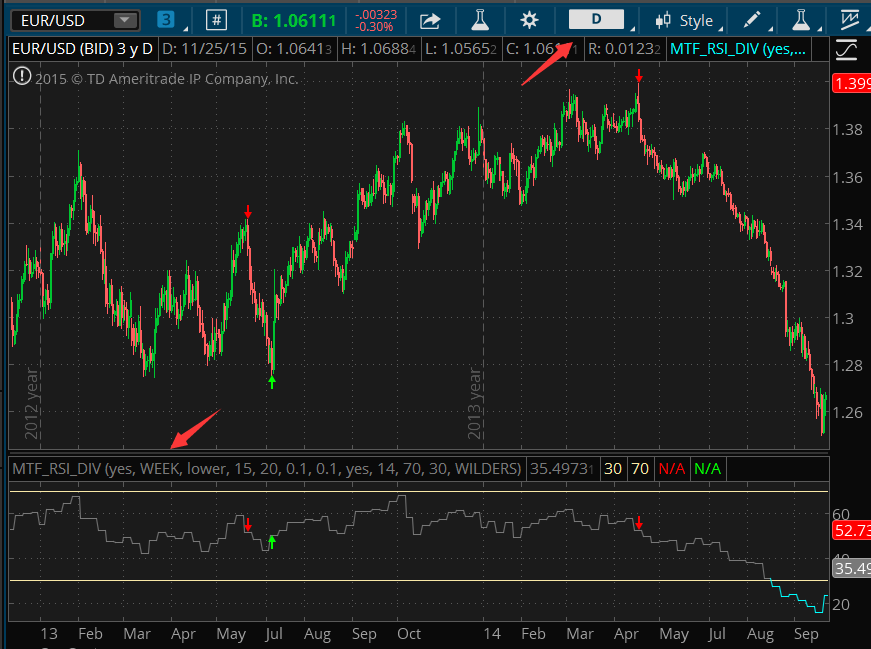
Introduction to Advanced Momentum Analysis
The Relative Strength Index (RSI) is one of the most widely used momentum oscillators in technical analysis, helping traders identify overbought and oversold conditions. However, its true power is often unlocked when it is used to detect divergence—a condition where the price of an asset and the indicator move in opposite directions. This discrepancy is a leading signal of a potential shift in market momentum. The Multi-Timeframe (MTF) RSI Divergence indicator for Thinkorswim elevates this concept by integrating the crucial element of multi-timeframe analysis, providing a more robust and less noisy signal for traders.
This article will detail the core concepts of RSI divergence, explain the benefits of multi-timeframe analysis, and provide a practical guide on how to use the MTF RSI Divergence indicator for Thinkorswim to enhance trading decisions.
Understanding RSI Divergence
Divergence occurs when the price action on a chart fails to confirm the momentum suggested by the RSI oscillator. This lack of confirmation suggests that the current trend is weakening and a reversal or continuation is likely. Divergences are categorized into two main types: Regular and Hidden, each with bullish and bearish variations.
Types of Divergence
| Type | Price Action | RSI Action | Signal Implication |
|---|---|---|---|
| Regular Bullish | Price makes Lower Lows | RSI makes Higher Lows | Signals a potential Bullish Reversal after a downtrend. |
| Regular Bearish | Price makes Higher Highs | RSI makes Lower Highs | Signals a potential Bearish Reversal after an uptrend. |
| Hidden Bullish | Price makes Higher Lows | RSI makes Lower Lows | Signals a Bullish Trend Continuation within an existing uptrend. |
| Hidden Bearish | Price makes Lower Highs | RSI makes Higher Highs | Signals a Bearish Trend Continuation within an existing downtrend. |
The detection of any of these patterns is a strong indication that a trader should prepare for a change in market behavior.
The Strategic Advantage of Multi-Timeframe Analysis
A common pitfall in technical analysis is focusing solely on a single timeframe, which can lead to “noise” and false signals. Multi-Timeframe (MTF) analysis is a disciplined approach that involves monitoring the same asset across different timeframes to gain a comprehensive view of the market structure.
The primary benefit of MTF analysis is trend confirmation. By using a higher timeframe (HTF) to identify the dominant trend and a lower timeframe (LTF) for precise entry and exit points, traders can ensure their actions are aligned with the broader market direction. This approach effectively filters out minor price fluctuations, leading to higher-probability trade setups. For instance, a trader might use a Daily chart to confirm a strong uptrend and then drop to a 15-minute chart to find a precise entry point based on a short-term pullback.
The MTF RSI Divergence Indicator
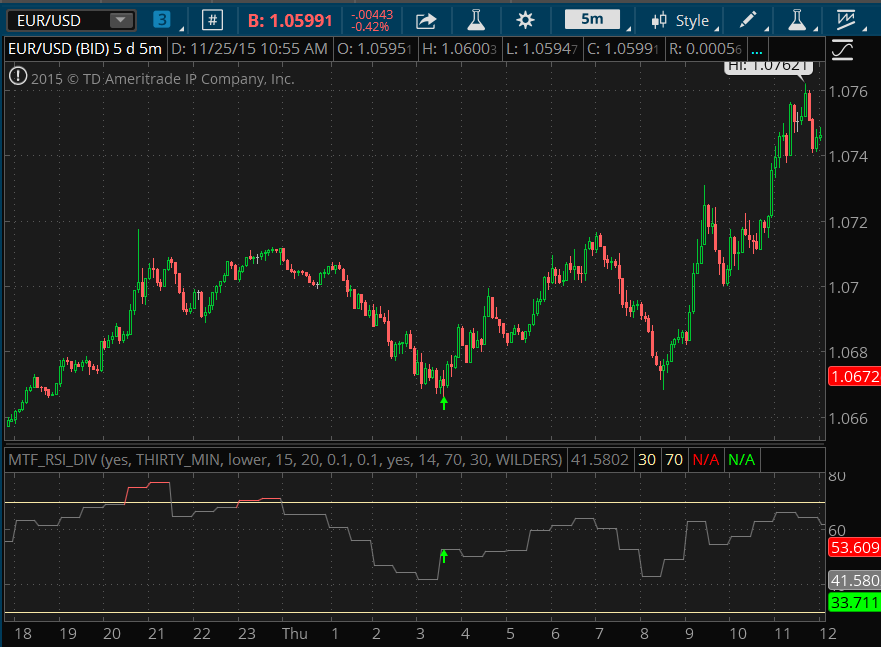
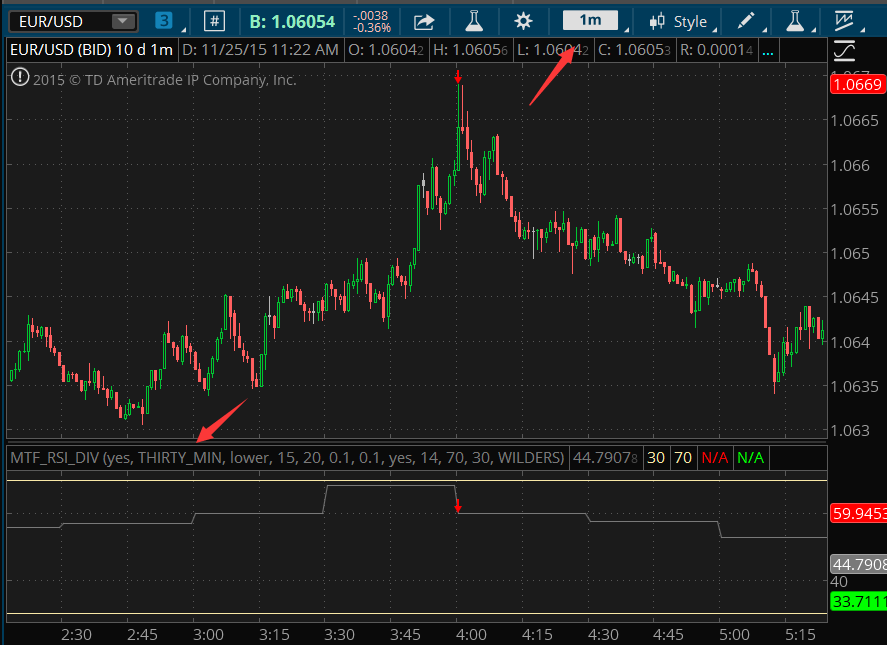
The MTF RSI Divergence indicator is designed to automate the process of cross-timeframe confirmation, specifically for divergence signals. By allowing the indicator to calculate RSI divergence on a higher timeframe and display the result on a lower timeframe chart, it provides an immediate, high-context signal.
Key Features and Technical Details
The specific indicator for Thinkorswim (TOS) is noted for several critical features that enhance its reliability:
- No Lag or Repaint: The signals are drawn directly on the current bar, meaning the indicator does not recalculate or change past signals. This is vital for real-time trading, as repainting indicators can mislead traders into believing a signal was present when it was not.
- Customizable Timeframe: The core functionality is the ability to set a specific timeframe (e.g., Weekly, Daily, 4-Hour) for the RSI calculation, regardless of the chart the trader is currently viewing.
- Integrated Scanning: The package often includes an Advanced RSI Divergence SCAN and Custom Quotes, allowing traders to monitor multiple symbols simultaneously for emerging MTF divergence signals without having to manually check each chart.
- Compatibility: It is important to note that this type of indicator typically works only on Time-based charts and not on Tick or Range charts, as the concept of a “timeframe” is central to its calculation.
Practical Application: How to Use the Indicator
Using the MTF RSI Divergence indicator effectively involves a three-step process: setup, signal identification, and trade execution.
Step 1: Indicator Setup and Configuration
The indicator is highly customizable, and proper configuration is essential for optimal performance.
- Timeframe Selection: Set the
timeframeinput to a period that is typically 4 to 6 times longer than your trading chart. For example, if you trade on a 1-Hour chart, set the MTF input to a 4-Hour or Daily timeframe. This higher timeframe provides the necessary context. - RSI Mode: To display the signal on both the price chart and the lower RSI sub-chart, the indicator must be added twice. Set one instance’s
rsi modeto upper (for the price chart) and the other to lower (for the sub-chart). Ensure all other inputs are identical for consistency. - Divergence Sensitivity: The
percentinput controls the sensitivity of the divergence detection. Setting this value to 0 will typically show all divergence signals, which can then be filtered by the trader. - RSI Parameters: Standard RSI inputs like
rsi period(default 14) and overbought/oversold levels (default 70/30) should be set according to the trader’s preference.
Step 2: Signal Identification and Confirmation
The MTF indicator provides a powerful layer of confirmation that single-timeframe divergence lacks.
- Identify the HTF Signal: The indicator will plot an arrow or a signal directly on your current (lower timeframe) chart, indicating that a divergence has occurred on the selected higher timeframe.
- Confirm with Price Action: Do not trade the signal in isolation. A valid MTF divergence signal should be confirmed by key price action elements on the lower timeframe, such as:
- A break of a trendline or a key support/resistance level.
- The formation of a reversal candlestick pattern (e.g., engulfing pattern, pin bar).
- A volume spike confirming the momentum shift.
- Align with Trend: The highest-probability trades are those where the MTF divergence signal aligns with the direction of the intermediate trend. For example, a Hidden Bullish Divergence on the HTF, signaling a continuation, provides a strong reason to enter a long trade on the LTF.
Step 3: Trade Execution and Risk Management
The MTF signal provides the context, and the LTF provides the precision for execution.
- Entry: Enter the trade on the lower timeframe immediately after the price action confirmation.
- Stop Loss: Place the stop loss based on the price action of the lower timeframe, typically just beyond the swing high or swing low that formed the divergence. This allows for a tight stop and a favorable risk-to-reward ratio.
- Take Profit: Targets can be set using the higher timeframe’s key support/resistance levels or by aiming for a fixed risk-to-reward ratio (e.g., 1:2 or 1:3).
Conclusion: Why the MTF RSI Divergence Indicator is Useful
The MTF RSI Divergence indicator is a valuable tool for technical analysts because it addresses the fundamental challenge of filtering market noise and gaining context.
By automating the detection of divergence across multiple timeframes, it provides:
- Increased Signal Reliability: Divergence confirmed by a higher timeframe is significantly more reliable than a signal generated on a single, lower timeframe.
- Superior Risk Management: The ability to enter a trade based on a precise LTF setup, while backed by a powerful HTF signal, allows for tighter stop losses and better trade management.
- Efficiency and Speed: The integrated scanning and watchlist features save time by automatically monitoring dozens of assets for high-probability setups, allowing the trader to focus only on charts that are actively signaling a potential move.
In summary, the MTF RSI Divergence indicator transforms a powerful, but often subjective, concept (divergence) into an objective, high-probability trading signal, making it an indispensable component of a disciplined technical analysis strategy.
Get it now: MTF(Multi Time Frame) RSI Divergence indicator, scan, watchlist(custom quotes) for Thinkorswim TOS
