How to Detect the First Bar of a New Signal
In trading indicator development, detecting the first bar of a new signal is an important part of building accurate alerts, clean chart signals, and reliable automated strategies. Many indicators produce conditions that remain true for multiple bars. If the logic does not identify only the first bar, the indicator may generate repeated alerts, duplicate trade entries, or misleading signal markers.
The key is to detect the exact moment when a signal changes from inactive to active. This is commonly known as detecting the first bar of a new signal.
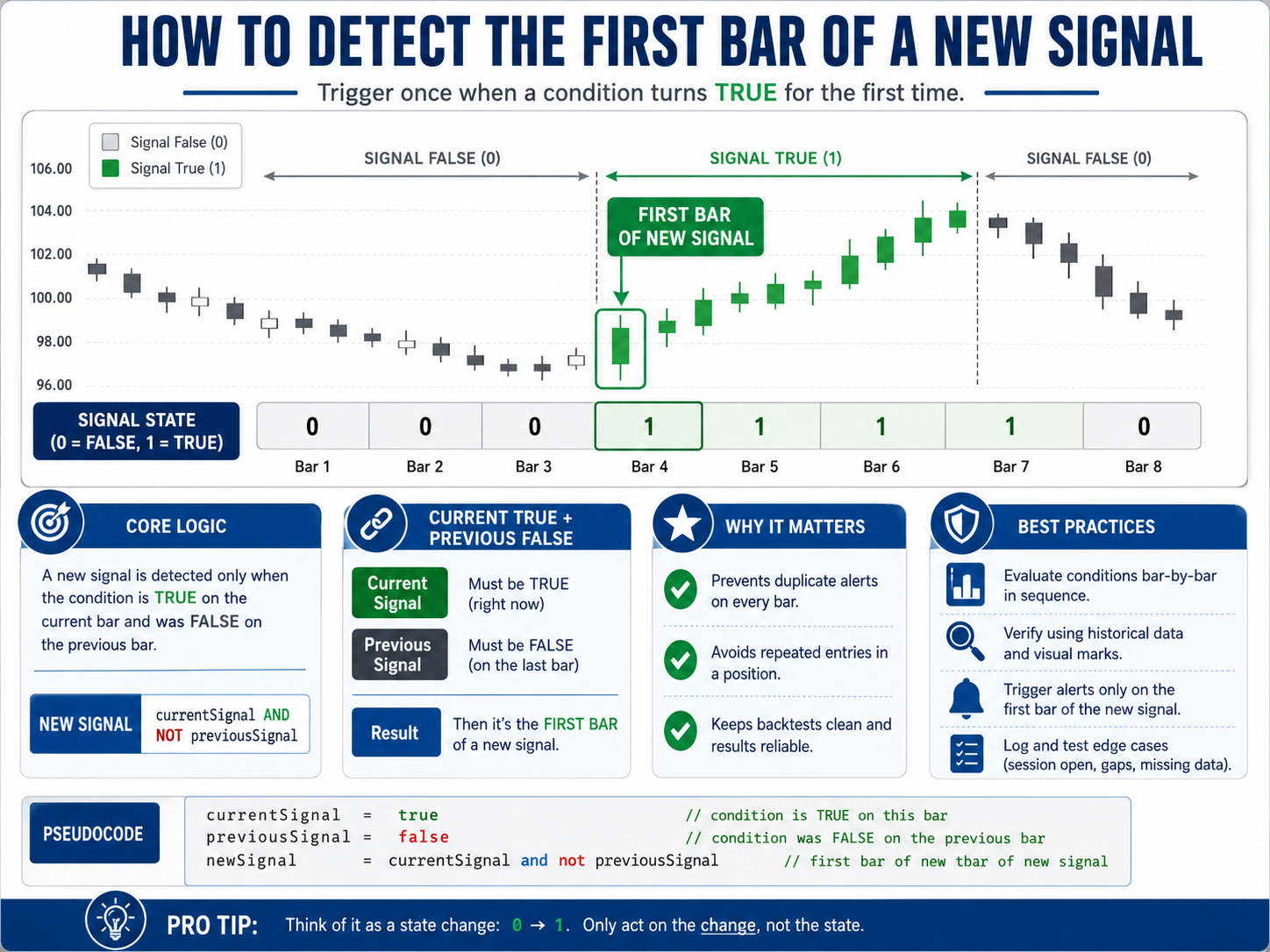
What Is the First Bar of a New Signal?
The first bar of a new signal is the first candle where a signal condition becomes true after previously being false.
For example, if a buy condition is false for several bars and then becomes true on the current bar, that current bar is the first bar of the new buy signal.
The basic logic is:
Current signal is true, and previous signal was false.
This helps separate a new signal from a signal that is simply continuing from previous bars.
Why Detecting the First Signal Bar Matters
Many trading indicators use conditions that can stay active for several candles. For example, price may remain above a moving average, a trend filter may stay bullish, or a momentum condition may remain valid for multiple bars.
Without first-bar detection, the indicator may treat every active bar as a new signal. This can cause several problems:
- Repeated buy or sell arrows
- Duplicate strategy entries
- Multiple alerts from the same signal
- Confusing chart output
- Inaccurate backtesting results
- Overtrading in automated systems
Detecting only the first bar allows the indicator or strategy to respond once when the signal begins.
Basic Logic for First-Bar Signal Detection
The most common method is to compare the current signal state with the previous bar’s signal state.
A new signal occurs when:
- The current bar signal is true
- The previous bar signal was false
In simple logic:
New Signal = Current Signal == True AND Previous Signal == False
This means the signal has just changed from inactive to active.
For numeric signal states, the same idea applies:
New Buy Signal = Current Signal == 1 AND Previous Signal != 1
New Sell Signal = Current Signal == -1 AND Previous Signal != -1
This method is reliable because it focuses on the transition, not just the condition itself.
Example: Buy Signal Detection
Suppose a buy condition is based on price crossing above a moving average:
Buy Condition = Close > Moving Average
If price stays above the moving average for ten bars, the condition may remain true for all ten bars. However, only the first bar should be considered the new buy signal.
The correct logic would be:
Buy Signal = Close > Moving Average
New Buy Signal = Buy Signal is true AND Buy Signal was false on the previous bar
This prevents repeated signals while the condition remains active.
Detecting the First Bar with Crossover Logic
For signals based on a value changing from one state to another, crossover logic is often useful.
For example:
Signal crosses from false to true
Signal crosses from 0 to 1
Price crosses above a moving average
Momentum crosses above zero
A crossover confirms that the condition did not simply remain active. It newly activated on the current bar.
This is especially useful for:
- Moving average crossovers
- Oscillator threshold signals
- Trend state changes
- Signal line crossings
- Breakout conditions
- Momentum confirmation
Handling Buy and Sell Signals Separately
When an indicator has both buy and sell signals, each direction should be detected independently.
Example logic:
New Buy Signal = Current Buy Condition is true AND Previous Buy Condition was false
New Sell Signal = Current Sell Condition is true AND Previous Sell Condition was false
For state-based systems:
New Buy Signal = Current State == 1 AND Previous State != 1
New Sell Signal = Current State == -1 AND Previous State != -1
This approach is useful when the indicator has three states:
1= bullish signal-1= bearish signal0= neutral or no signal
By checking for a change into a new state, the indicator can detect the first bar accurately.
Common Mistakes When Detecting New Signals
1. Checking Only the Current Condition
A common mistake is using only the current signal condition:
If Buy Condition is true, trigger a buy signal
This will trigger on every bar where the buy condition remains true. To detect the first bar, the previous bar must also be checked.
2. Ignoring the Previous Bar
The previous bar tells you whether the signal is new or continuing. Without comparing the current signal to the previous signal, the script cannot know whether the signal just started.
3. Not Handling the First Chart Bar
On the first available bar, there may be no previous bar to compare. The code should include a safety check to avoid referencing missing historical data.
For example:
If there is not enough historical data, do not calculate the signal yet.
4. Mixing Intrabar and Closed-Bar Logic
Signals can appear and disappear while a candle is still forming. If the script calculates on every tick, the “first bar” may change before the bar closes.
For more reliable signals, many strategies use closed-bar confirmation, especially for backtesting and automated trading.
5. Not Separating Candidate Signals from Confirmed Signals
Some indicators produce early candidate signals before confirmation. A candidate signal may not be reliable enough for execution.
A better structure is:
Candidate Signal = early condition
Confirmed Signal = final condition after validation
New Confirmed Signal = Confirmed Signal is true AND Previous Confirmed Signal was false
This keeps signal detection clean and avoids acting on temporary conditions.
First-Bar Detection in Automated Trading
For automated trading strategies, detecting the first bar of a new signal is essential. If the strategy does not filter repeated signals, it may submit multiple orders for the same setup.
This can cause:
- Repeated entries
- Unexpected position scaling
- Overlapping orders
- Incorrect backtest results
- Poor live execution control
A strategy should usually act only when a new signal begins, not on every bar where the condition remains true.
First-Bar Detection for Alerts
The same concept applies to alerts. If an alert is triggered whenever the signal condition is true, the trader may receive repeated notifications for the same setup.
Using first-bar detection ensures that alerts are sent only when the signal first appears.
Example:
Alert Condition = New Signal is true
Not:
Alert Condition = Signal is true
This creates cleaner and more useful notifications.
Best Practices for Detecting the First Signal Bar
To build reliable first-bar detection logic, follow these best practices:
- Compare the current signal with the previous signal
- Detect the transition from false to true
- Use state values for buy, sell, and neutral conditions
- Add safety checks for the first few bars
- Use closed-bar logic when signals must be confirmed
- Store signal states clearly
- Separate temporary signals from confirmed signals
- Test the logic bar by bar
- Verify results in both historical and real-time data
The most important rule is simple: a new signal is not just a true condition. It is a transition into a true condition.
Conclusion
Detecting the first bar of a new signal is a fundamental technique in trading indicator development. It helps prevent duplicate arrows, repeated alerts, and multiple strategy entries from the same signal condition.
The core logic is straightforward: the current signal must be true, and the previous signal must be false. For state-based systems, the current state should be different from the previous state and match the desired signal direction.
By using proper first-bar detection, traders and developers can create cleaner indicators, more accurate alerts, and more reliable automated trading strategies.