In the world of automated trading, “signal duplication” is a silent killer of equity curves. It occurs when a trading algorithm generates multiple entry commands for the same market move, leading to over-leveraging, excessive commissions, and skewed risk management.
For developers and quantitative traders, coding a logic that says “Buy” is only half the battle. The other half is ensuring the system doesn’t say “Buy” five more times while the first trade is still active. Here is how to architect your strategy code to ensure execution remains clean and singular.
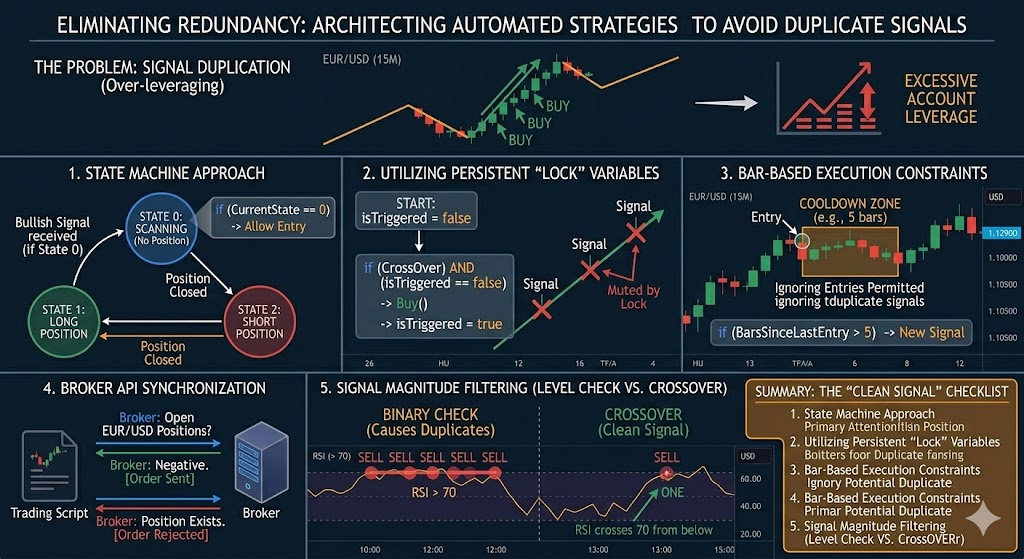
1. The “State Machine” Approach
The most robust way to prevent duplicate signals is to implement a basic state machine within your code. By creating a variable that tracks the current “state” of the strategy, you can prevent the execution engine from firing redundant orders.
The Logic:
- State 0: No Position (Scanning for entry)
- State 1: Long Position Active
- State 2: Short Position Active
Coding Implementation: Before your signal logic, add a conditional check: if (CurrentState == 0) { // Only scan for new signals if no position is open }
Once a trade is executed, the script updates the state to 1 or 2, effectively “muting” the signal generator until the trade is closed and the state resets to 0.
2. Utilizing Persistent “Lock” Variables
In environments like Pine Script or Python (Pandas), signals are often calculated on every bar. Without a “Lock,” a trend-following crossover might trigger a buy signal on every single candle as long as the fast MA is above the slow MA.
To fix this, use a boolean “Trigger Lock”:
- Set
isTriggered = falseas a default. - When a crossover occurs: Check if
isTriggeredis false. - Execute trade: Immediately set
isTriggered = true. - Reset: Only set
isTriggeredback to false once a cross-under (exit) occurs.
3. Bar-Based Execution Constraints
A simple but effective way to stop duplicate signals is to restrict the strategy to one trade per “X” number of bars. This is particularly useful for scalping strategies that might otherwise attempt to enter ten times during a single volatile price spike.
Example Logic: if (BarsSinceLastEntry > 5) { // Allow new signal }
By forcing a “cool-down” period, you ensure that the market has moved into a new phase before the algorithm is allowed to commit more capital.
4. Integration with Broker API Synchronization
Sometimes the “duplicate” isn’t in your code, but in the communication between your script and the broker. If a script sends a market order but doesn’t receive an instant confirmation, it might send a second order.
Professional Solution: Before sending an order, your code should query the broker’s API for “Open Positions.”
- Pseudo-code:
if (Account.HasOpenPosition("EURUSD") == False) { SendOrder(); }
This creates a hardware-level fail-safe that prevents your account from opening duplicate “legs” on the same pair.
5. Signal Magnitude Filtering (The “Threshold” Method)
In mean-reversion strategies, indicators like the RSI can stay in “overbought” territory for many bars. A basic script might trigger a “Sell” signal every time the RSI is above 70.
Instead of a binary check (RSI > 70), code the strategy to trigger only when the RSI crosses the 70 level from below.
Summary: The “Clean Signal” Checklist
| Method | Best For | Complexity |
|---|---|---|
| State Tracking | General Trend Following | Medium |
| Trigger Locks | Oscillators (RSI/Stochastic) | Low |
| API Syncing | Live Execution / Bot Trading | High |
| Bar Constraints | High-Frequency Scalping | Low |
Conclusion
Avoiding duplicate signals is about building a “memory” into your trading algorithm. An algorithm that knows what it did five minutes ago is far more successful than one that only sees the current price tick. By implementing state machines, trigger locks, and API synchronization, you ensure your automated strategy operates with the surgical precision required for long-term profitability.
Click here If you are looking for Professional Custom Trading Software Development Services