In algorithmic trading, the Moving Average Crossover is often the first strategy a developer codes. It’s conceptually simple: when a fast-moving average crosses above a slow-moving average, you buy.
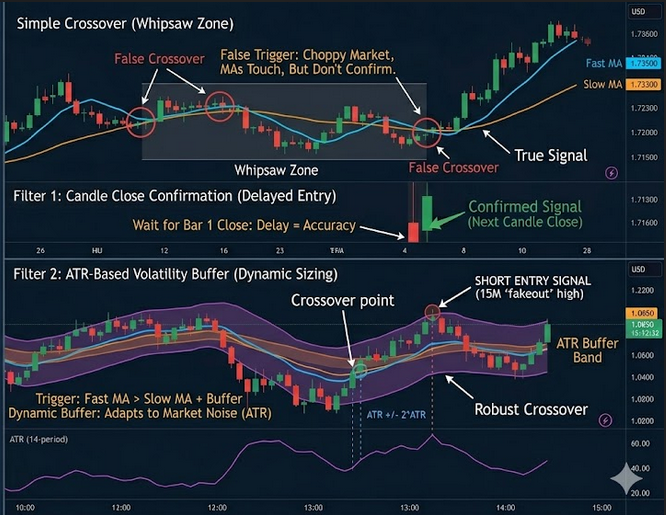
However, the reality of the market is messy. In sideways or “choppy” markets, indicators frequently crisscross, creating false triggers (whipsaws) that can bleed a trading account dry through commissions and small losses. To build a robust trading bot, you must code filters that demand more than just a simple mathematical intersection.
1. Implement a “Price Buffer” (The Minimum Distance)
The most common false trigger occurs when the two lines are “touching” rather than “crossing.” To solve this, don’t trigger a signal the moment FastMA>SlowMA. Instead, require the difference to exceed a specific threshold.
The Logic: Instead of if (fast > slow), use: if (fast > (slow + buffer))
This buffer can be a fixed pip/point value or, more effectively, a percentage of the asset’s price. This ensures the crossover has enough momentum to be considered a valid trend shift.
2. Use the “Candle Close” Confirmation
A common mistake among novice coders is calculating signals on the current (live) candle. Because price fluctuates, a crossover might appear at the 30-second mark of a 1-minute candle, only to disappear by the time the candle closes.
The Fix: Always reference the index [1] (the previous, completed candle) rather than index [0] (the open candle).
Rule of Thumb: A signal is only “confirmed” once the timeframe period has fully elapsed. This single change eliminates “ghost” signals that vanish from the chart.
3. Integrate Volatility Filters (ATR)
Markets behave differently in high-volatility regimes versus low-volatility ones. A 5-point crossover in a stagnant market might be a fluke, while the same crossover during high volume could be a breakout.
By using the Average True Range (ATR), you can make your buffer dynamic.
- High Volatility: Require a larger crossover distance (2×ATR).
- Low Volatility: Allow for a tighter entry.
4. The “Time-Delay” or Bar-Count Filter
If you want to ensure a trend is sustainable, code a requirement that the fast moving average must stay above the slow moving average for X number of bars before an order is executed.
- Logic:
If (Fast > Slow) for 3 consecutive candles -> Trigger Buy. - Result: This filter sacrifices a bit of the early move to guarantee you aren’t entering on a temporary price spike.
5. Multi-Timeframe (MTF) Alignment
One of the most effective ways to filter false triggers is to check the “Higher Timeframe” (HTF) trend. If you are coding a crossover on a 15-minute chart, your code should verify that the price is also above a long-term Moving Average (like the 200-period) on the 4-hour chart.
The Filter Logic:
- Lower Timeframe (15m): Fast MA crosses Slow MA.
- Higher Timeframe (4h): Price is above 200 EMA.
- Action: Only execute if both conditions are true.
Summary Table: Filtering Techniques
| Technique | Coding Difficulty | Impact on Noise | Trade-off |
|---|---|---|---|
| Candle Close | Easy | High | Slight entry delay |
| Price Buffer | Easy | Medium | Misses very small moves |
| ATR Filter | Moderate | High | Requires dynamic math |
| MTF Confirmation | Hard | Very High | Fewer total trade setups |
Conclusion
Coding a crossover signal is easy; coding a profitable one is an exercise in restraint. By moving away from “instant” triggers and implementing buffers, ATR filters, and multi-timeframe confirmations, you transform a basic script into a sophisticated trading tool. Remember: in the world of automated trading, the trades you don’t take are often just as important as the ones you do.
Click here If you are looking for Professional Custom Trading Software Development Services