Confirmed Daily Candles on Intraday Charts: Avoiding Higher-Timeframe Lookahead Bias
Introduction: a daily candle can change while the day is still trading
An intraday chart may display a higher-timeframe daily price, daily trend filter or daily indicator. The tempting mistake is to treat the current day's developing value as though it were yesterday's completed fact. During the trading session, the current daily high can rise, the low can fall, and the would-be daily close is simply the latest traded price or available bar close. A signal appearing at noon can disappear by the final daily close without any error in the market data.
The practical question is not merely whether a daily signal is bullish. It is: which daily bar did the signal use, when did that bar become final, and when could the trader have known its value? Those timestamps decide whether an intraday strategy is reproducible or accidentally uses information from the future.
The same daily candle can produce opposite provisional conclusions
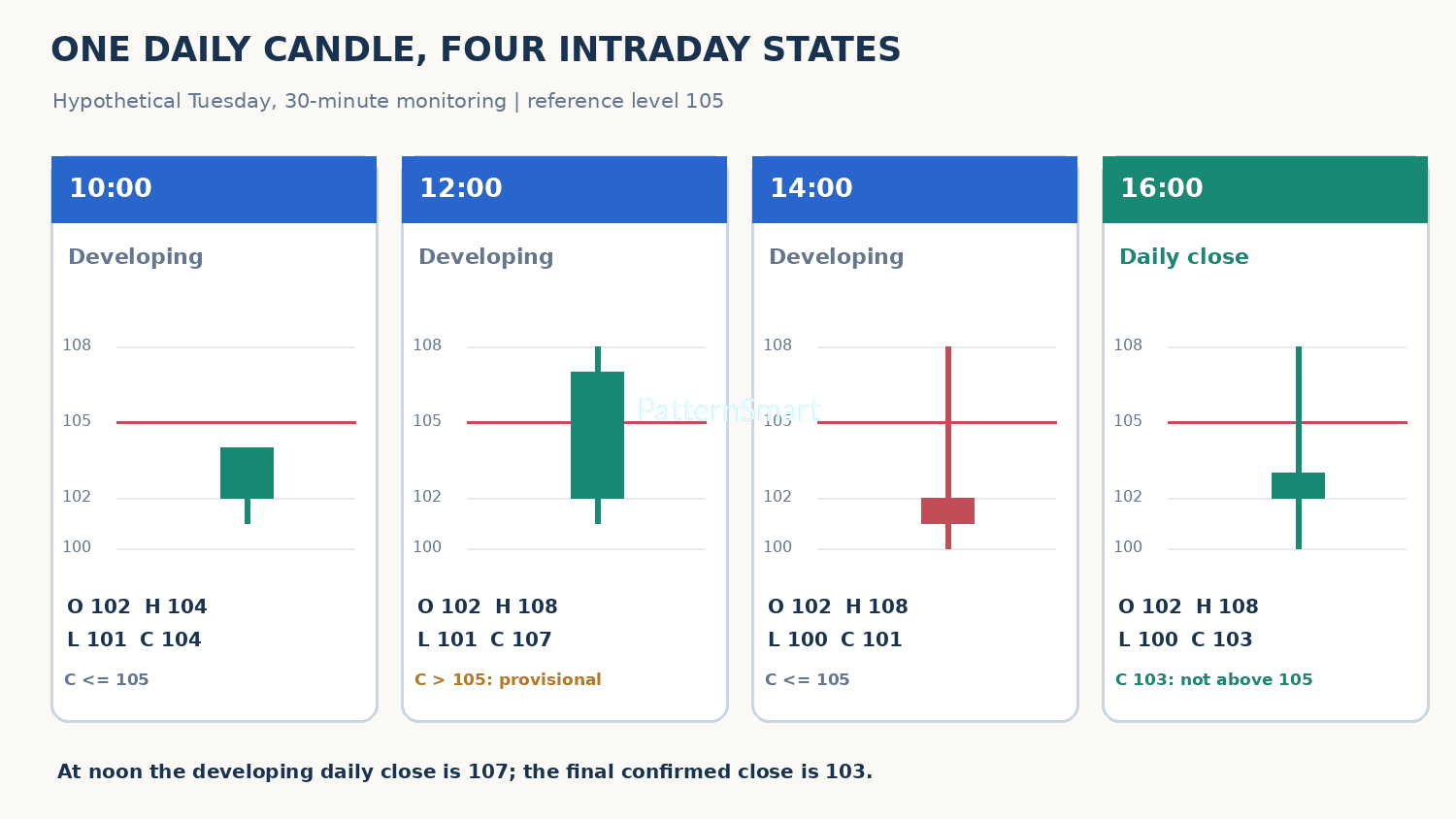
Imagine a hypothetical regular trading session on Tuesday with a daily open of 102 and a close-above-105 bullish filter. At 10:00 the developing daily candle has O=102, H=104, L=101 and provisional C=104. At noon, it has O=102, H=108, L=101 and provisional C=107. Thus the provisional daily close exceeds 105. At 14:00 the same candle has O=102, H=108, L=100 and C=101. At 16:00 the final completed bar has O=102, H=108, L=100 and C=103.
The high remains 108 after noon and the low can only move down during this particular bar's construction; the changing close is what cancels the supposed closing breakout. The session did trade above 105, but the actual completed daily closing price did not. A midday alert may legitimately describe an intraday crossing. It must not be mislabeled as a confirmed daily close above 105. All data in this illustration are invented teaching numbers, not historical prices.
A data-availability rule every strategy needs
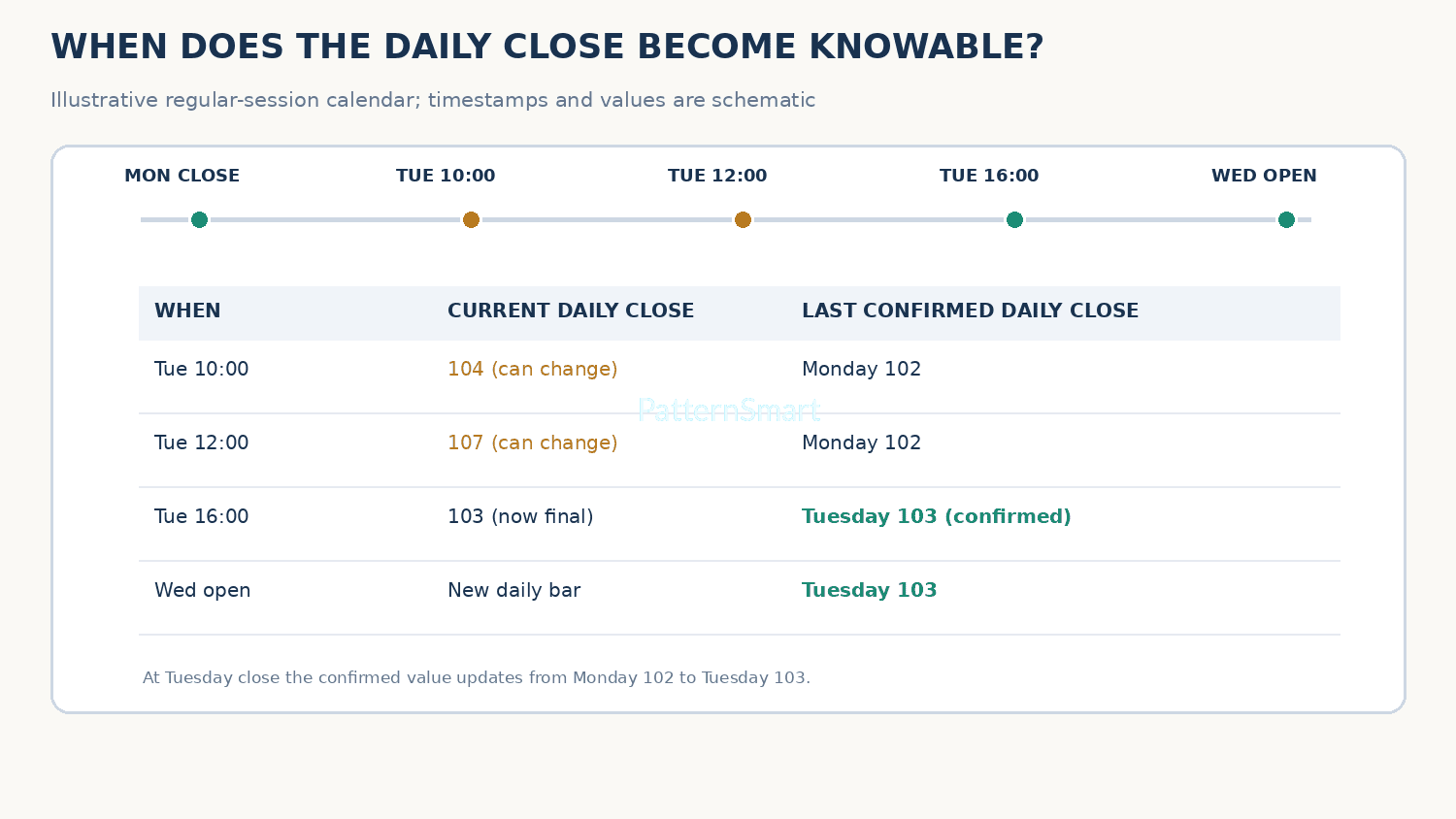
Let D[t] be the final daily close on day t, and let D[t,u] be the developing value observable at intraday time u before day t ends. During Tuesday, D[Tuesday,u] may vary (104, 107, then 101), whereas D[Monday] is already fixed at 102. Once Tuesday's designated daily session ends, its final close becomes D[Tuesday]=103. At the beginning of Wednesday, Tuesday's completed 103 can be used as the most recent confirmed daily close.
A no-lookahead higher-timeframe context filter may therefore use the most recent completed daily bar. On intraday bars before Tuesday's daily close, that means Monday's completed value, not Tuesday's unfinished close. Immediately after the daily close, the new confirmed 103 becomes available. This is a rule about information availability, not a claim that the previous day's close will predict the next day's direction.
Two legitimate designs, but they answer different questions
Design A, confirmed-only: calculate the higher-timeframe signal solely from completed daily candles and hold that last confirmed value while new intraday bars arrive. The signal is stable during the next daily candle, though naturally delayed. This is often appropriate for daily trend filters or backtests that must behave similarly in historical and live conditions.
Design B, developing-now: deliberately monitor the current unfinished daily candle as an early warning or intraday measurement. It can respond sooner, but it can also change or vanish before the close. If a strategy trades on this event, its backtest must reproduce the same intraday observations and their sequence. It cannot pretend the developing observation was the day's final value. Label these events 'provisional' rather than 'confirmed' and evaluate their false-alert rate separately.
Neither design is universally better. The choice depends on whether the research question is about a completed daily condition or a real-time intraday probe of that condition. Mixing the two creates invalid comparisons.
Worked example: apparent agreement between timeframes
Suppose a 30-minute rule looks for a local bullish close while a daily filter demands a daily close above 105. Tuesday at noon, the 30-minute chart may produce a bullish signal while the forming daily close is 107. Under Design B the trader can act on a provisional daily reading of 107, accepting that the daily condition may disappear. Under Design A, Tuesday's still-unconfirmed daily close is not eligible. Monday's last completed daily close of 102 is below 105, so the strict daily filter is false throughout the developing Tuesday session.
After Tuesday's close, the final daily value is 103—still below 105—so the completed daily condition was never met that day. If historical results show noon's trade as having enjoyed a confirmed daily close above 105, that result is using hindsight. It is equally wrong to read Tuesday's final 103 into the morning's data as though the final price was already known. Both errors violate the chronological information set.
Implementation and platform pitfalls
In multi-timeframe scripts, the method used to merge higher-timeframe data into lower-timeframe bars matters as much as the formula. Some data requests can expose unconfirmed higher-timeframe values on live bars; other combinations of lookahead settings and offsets can accidentally assign future completed values to earlier historical timestamps. TradingView's published Pine Script documentation discusses this explicitly. For a higher-timeframe series, its documented non-repainting technique uses an offset to the prior completed higher-timeframe value together with the appropriate lookahead merge setting; copying 'lookahead on' without the offset can leak future data.
The article is not providing or claiming tested executable Pine Script, because the underlying principle is platform-independent. Regardless of platform, record the requested timeframe, session calendar, data-adjustment convention, the time at which a higher-timeframe bar becomes final, and whether the API returns provisional or completed values. Do not assume a lower-timeframe bar's close means the larger bar is also complete. Time zones, holidays, extended sessions and overnight markets can change the boundary.
How to test without future leakage
Construct a point-in-time table containing each intraday event's timestamp, the then-visible developing daily OHLC, the latest completed daily OHLC, the signal state, and the decision time. In a strict confirmed-only backtest, use only the already completed higher-timeframe values that were actually available then. If building a provisional-signal strategy, preserve every intraday update and test the resulting alerts under the same session and data rules. Randomly shuffling bars, backfilling the final daily close onto morning timestamps or revising historical alerts after bar close destroys the experiment.
Compare confirmed-only and provisional versions using the same entry and exit rules, realistic spread, latency, commissions and slippage. Report entry delays, signal changes, cancelled provisional alerts, false breakout frequency, trade frequency and drawdown. A lower-alert or higher-return result in one historical sample does not establish that one implementation is superior out of sample.
Common mistakes and what to monitor
Do not describe a midday excursion above resistance as a confirmed daily close. Do not use the current daily candle's final high, low or close in an intraday decision made before that information existed. Do not assume bar labels automatically correspond to exchange closing times. Do not mistake the movement of a still-forming higher-timeframe indicator for evidence that an algorithm repaints completed historical signals. Distinguish expected provisional updates from unwanted retroactive changes to past decisions.
An effective audit log can record 'source bar date', 'source bar confirmed at', 'intraday decision timestamp', 'value as of decision', and 'signal provisional/confirmed'. Teams implementing repeatable multi-timeframe indicators and testing workflows can explore Custom Trading Software Development Services to translate the desired information-availability rules into software. This article contains an educational concept, not a downloadable free program.
Risk disclosure and conclusion
The essential improvement is chronological honesty: an unfinished daily bar is useful live information, but it is not a completed daily fact. Confirmed-only methods introduce delay, while provisional methods introduce changing signals; both can lose money, and neither guarantees predictive value. The numerical snapshots and diagrams here are hypothetical. Price gaps, leverage, slippage, liquidity constraints and coding errors can materially affect results. This is technical-analysis education, not individualized investment advice.