Breakout Retests and Failed Breakouts: A Close-Based Resistance Framework
A breakout is an event, not a prediction
Resistance is a reference area where previous advances stalled. A close above a predefined boundary is an observable event, not proof that buyers will maintain control. A retest and a failed breakout describe subsequent behavior; neither should be retroactively attached to the original signal.
Define the level before the signal
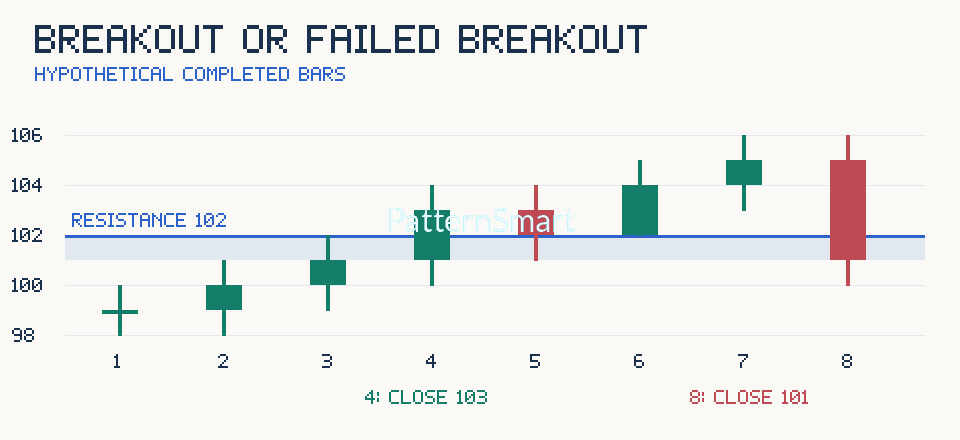
Suppose a hypothetical resistance boundary is 102, identified from the first three completed bars. Use a strict close above 102 as the initial breakout rule. A wick above 102 followed by a close at or below 102 does not qualify. In practice a predefined zone or minimum tick buffer may be more appropriate than an exact price; do not move the boundary after seeing the outcome.
Eight-bar worked example
The hypothetical chart uses closes of 99, 100, 101, 103, 102, 104, 105 and 101. Bar 4 closes at 103 and confirms the initial breakout. Bar 5 trades as low as 101 and closes at 102: this is a boundary retest, not a fresh breakout. Bar 6 closes at 104 and provides renewed evidence above resistance. Bar 8 closes at 101, below the original boundary, and invalidates a rule requiring closes to remain at or above 102. The earlier breakout was real under its definition even though it subsequently failed.
Separate confirmation from invalidation
A strict retest rule might require a low at or below 102 followed by a close at or above 102, then a later close above the retest bar high of 104. In this example bar 7, closing at 105, satisfies that last condition; bar 6 at 104 does not. A more conservative rule requiring the retest itself to close strictly above 102 would reject bar 5. Choose one rule before testing, and log each decision when it becomes knowable.
Risk and execution
An illustrative entry reference of 105 and stop reference of 101 imply four price units of planned risk per unit, before costs. With a hypothetical risk budget of 200 and a multiplier of one, the arithmetic ceiling is 50 units before fees and slippage. Actual fills may be worse, and a close-based exit is not equivalent to a resting stop order. Gaps may exceed the planned loss.
Common mistakes and validation
Avoid drawing resistance using future highs, treating a wick as a confirmed close, assuming every breakout must retest, or counting only successful retests. Compare immediate breakout entries with retest-confirmed entries on chronological holdout data. Include missed trades, spread, commissions and slippage; measure net expectancy, drawdown and signal frequency. A buffer can reduce some marginal signals but may also delay entries. For custom alerts that preserve these separate states, explore Custom Trading Software Development Services.
Risk disclaimer
All prices and bars are hypothetical teaching examples, not historical market data or verified performance. Technical analysis cannot guarantee future returns. Trading involves risk of loss; this article is educational, not investment advice.