In algorithmic trading, utilizing multiple timeframes (MTF) is one of the most effective ways to build a comprehensive market perspective. A classic multi-timeframe strategy uses a higher timeframe (HTF) chart—like a 4-hour or Daily chart—to determine the macro trend, while executing entries on a lower timeframe (LTF) chart—like a 5-minute or 15-minute chart.
However, MTF architectures introduce a devastating flaw if coded incorrectly: Multi-Timeframe Look-Ahead Bias.
This bias occurs when data from an unclosed, higher-timeframe candle is retroactively mapped to the beginning of that period on a lower-timeframe chart. In a backtester, this means your 5-minute strategy is making decisions based on a Daily closing price that hasn’t actually happened yet. The result? Flawless, highly profitable historical simulations that completely collapse the moment they hit live market data.
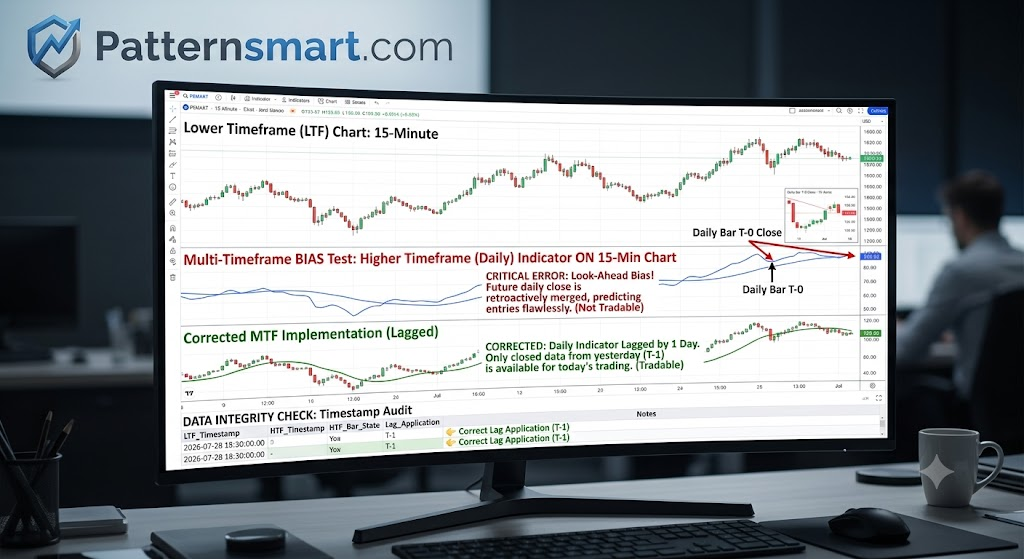
1. The Mechanics of the MTF Leak
To understand how this leak happens, we must look at how data frames align different granularities of time. Consider a daily candle. A single daily bar spans 24 hours of trading. On a 15-minute chart, that single daily bar corresponds to 96 individual 15-minute bars.
Daily Scale:  [----------------------- Day T -----------------------]
               |                                                   |
15-Min Scale: [Bar 1][Bar 2][Bar 3] ... [Bar 94][Bar 95][Bar 96 (Close)]
If your code requests the Close price of “Day T” while the backtester is simulating “Bar 1” of the 15-minute scale, what happens?
- The Reality: In live trading, at Bar 1 (00:15 AM), the final closing price of the day is completely unknown.
- The Backtest Flaw: In a naive backtest, the data engine looks at the historical database, sees the finalized value for Day T’s Close, and makes it available to all 96 constituent sub-bars instantly.
Your indicator effectively “looks into the future” to see how the day will end, allowing your system to enter a perfect long position at 00:15 AM because it already knows the day will finish green.
2. Platform-Specific Traps and Solutions
Different algorithmic frameworks handle MTF data access uniquely. Failing to understand the defaults of your specific platform is the primary cause of MTF bias.
A. TradingView Pine Script (The request.security Trap)
In Pine Script, pulling data from a higher timeframe is achieved via the request.security() function. Historically, this function was a primary source of look-ahead bugs.
Pine Script
// HIGHLY DANGEROUS - CONTAINS LOOK-AHEAD BIAS
// This fetches the current day's close before the day is over.
dailyCloseRealtime = request.security(syminfo.tickerid, "D", close)

// SAFE - PREVENTS LOOK-AHEAD BIAS
// By using historical indexing [1] and turning off lookahead,
// you ensure you only fetch the PREVIOUS day's fully closed data.
dailyCloseSafe = request.security(syminfo.tickerid, "D", close[1], barmerge.gaps_off, barmerge.lookahead_off)
To remain structurally safe in Pine Script, always pass the lagged series close[1] into the security function, ensuring that the lower timeframe only acts upon data that has explicitly crossed its historical finish line.
B. Python / Pandas (The Resampling Pitfall)
When building a custom backtester in Python, developers frequently use .resample() to calculate macro indicators, then merge those indicators back onto a micro dataframe.
Python
# The Wrong Way: Merging unshifted HTF data
df_daily = df_15min.resample('D').last()
df_daily['sma_20'] = df_daily['close'].rolling(20).mean()

# DANGEROUS: Left-joining directly maps the final daily SMA to the start of the day
df_merged = df_15min.join(df_daily['sma_20'], how='left').ffill()
Because the index matches the start of the day window, ffill() distributes the future daily calculation backward to the early morning 15-minute bars.
The Fix: You must explicitly shift the higher timeframe series by one interval before forward-filling the data onto the lower timeframe array:
Python
# SAFE: Shift the daily calculations forward by 1 day
df_daily_safe = df_daily['sma_20'].shift(1)

# Now, the 15-min bars only see yesterday's finalized daily SMA
df_merged_safe = df_15min.join(df_daily_safe, how='left').ffill()
3. The Multi-Timeframe Compliance Framework
To guarantee your indicators are structurally sound, implement a mandatory Data Availability Protocol across your development workflow.
[Fetch HTF Bar T] ──> [Apply 1-Bar Lag (T-1)] ──> [Broadcast to LTF Array] ──> [Execute Strategy Logic]
- The “Bar-1” Mandate: Treat any higher timeframe variable as non-existent for the current period. If you want to use a Daily Moving Average on a 5-minute chart, you may only use the value of that Moving Average as of yesterday’s close.
- Strict Timestamp Alignment: When merging data streams, always align the availability timestamp rather than the start timestamp. A daily bar starting at 00:00 AM on Monday is not available until 00:00 AM on Tuesday. Your merge keys must reflect the completion time, not the initiation time.
- Avoid Mid-Bar Lookups: If your strategy dictates that it must track the developing HTF bar in real time (e.g., watching a daily volume breakout as it happens on the 5-minute chart), you must calculate that metric using cumulative lower-timeframe slices rather than requesting the unclosed HTF parent bar.
4. How to Audit Your MTF Strategy
If you suspect your strategy is benefiting from an accidental peek into the future, use the Timestamp Discrepancy Audit:
Print out a combined CSV file of your backtest logs containing four specific columns: LTF_Timestamp, HTF_Timestamp_Used, LTF_Price, and HTF_Indicator_Value.
Scroll to a major market turning point—like a sharp macro reversal. Look closely at the HTF_Indicator_Value assigned to the very first lower-timeframe bar of that period. If the indicator has pivoted or shifted direction on the first sub-bar before the price action of the subsequent sub-bars has occurred, your data pipeline is leaking. The indicator must remain flat, holding the previous period’s value, until the final sub-bar of that macro window completes. If it moves early, your backtest is an illusion.
Contact us if you are looking for Professional Custom Trading Software Development Services