Position Sizing by Stop Distance: Why Wider Stops Require Smaller Trades
A stop-loss level describes where a trading idea is invalidated; position sizing determines how much capital is exposed if that level is reached. Treating these as separate decisions is a frequent risk-management error. The practical sequence is to identify a defensible stop first, set a monetary risk budget second, and calculate quantity last.
The core calculation
For a linear stock position priced in the account currency, risk per share = |planned entry − planned stop|. The maximum whole-share quantity under a fixed planned loss budget is floor(risk budget / risk per share). This is a planned-loss approximation, not a guarantee of execution at the stop price. Fees, gaps, spread and slippage can increase realized loss.
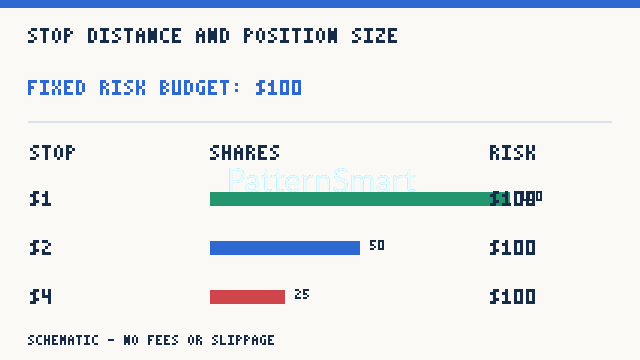
Suppose an account has $20,000 and the trader chooses to risk 0.5% on a single idea. The planned budget is $100. For a hypothetical stock entered at $50, a $49 stop is $1 away, allowing 100 shares; a $48 stop is $2 away, allowing 50 shares; a $46 stop is $4 away, allowing 25 shares. All three configurations have the same $100 planned price-to-stop loss, before costs. These are illustrative figures, not historical trades.
Stop placement should follow market structure, not the desired quantity
A technically justified stop might sit beyond a swing low for a long trade, outside a support zone, or beyond a volatility-adjusted invalidation threshold. The distance is a consequence of the trade thesis. Moving a stop closer merely to buy more shares can put it inside ordinary market noise. Moving it farther after entry without reducing quantity increases the originally budgeted loss.
A complete worked example
Consider a hypothetical long setup with an intended entry at $80.00 and an invalidation level at $77.50. The stop distance is $2.50. A $150 planned risk budget permits floor(150 / 2.50) = 60 shares, requiring $4,800 of purchase capital before fees. If available buying power is only $3,000, the affordable quantity is floor(3000 / 80) = 37 shares, so the actual limit is 37, not 60. Its planned stop loss is $92.50, excluding costs.
| Constraint | Calculation | Result |
|---|---|---|
| Risk budget | $150 / $2.50 | 60 shares maximum |
| Cash available | $3,000 / $80 | 37 shares maximum |
| Allowed quantity | Minimum of both limits | 37 shares |
| Planned price-to-stop loss | 37 × $2.50 | $92.50 |
Different instruments require different unit values
For a futures contract, risk per contract is the stop distance in index points or price units multiplied by the contract's verified dollar value per point, plus a reasonable cost allowance. For FX, convert pip value into the account currency for the exact pair and lot size. For options, nonlinear pricing, spreads, time decay and contract specifications make a simple underlying-price stop-distance formula inadequate. Never reuse the stock-share equation blindly across products.
Practical confirmation and execution checklist
Confirm that the invalidation level is logically tied to the setup, the entry and stop use the same instrument and units, contract multipliers are correct, sufficient liquidity exists, and total correlated exposure is considered. If the stop is too far away to trade even the minimum permitted lot or contract within the budget, skip the setup rather than override the risk cap. A stop order may execute worse than its trigger price; a stop-limit order may fail to fill.
Common mistakes and limitations
Three recurring mistakes are sizing first and inventing the stop afterward, forgetting commissions and gap risk, and increasing size because the chart looks convincing. Another is assuming a constant percentage risk makes a strategy profitable. It does not: win rate, average win versus loss, costs and adverse market regimes still determine outcomes. Risk budgets also aggregate across open positions; five individually small but highly correlated trades may create one large directional exposure.
A software-based position-size calculator can make these constraints visible before an order is placed. For teams adapting this educational calculation to specific contracts or broker workflows, see Custom Trading Software Development Services.
Key takeaway
The wider the defensible stop, the smaller the position for a fixed planned risk budget. Start with invalidation, then risk allowance, then quantity. This framework controls intended exposure; it cannot eliminate losses from gaps, liquidity shortages or execution uncertainty.
Risk disclaimer: Educational material only, not investment advice or a recommendation to trade. Trading can result in losses exceeding the planned stop-based amount, particularly with leverage or volatile markets.