Pullback entry strategies often appear attractive because they avoid buying immediately after a breakout. Their reported returns, however, can depend heavily on whether historical limit orders are treated as filled when price merely touches the requested level. This is an execution-model sensitivity test, not a new prediction indicator.
Two paths, one order price
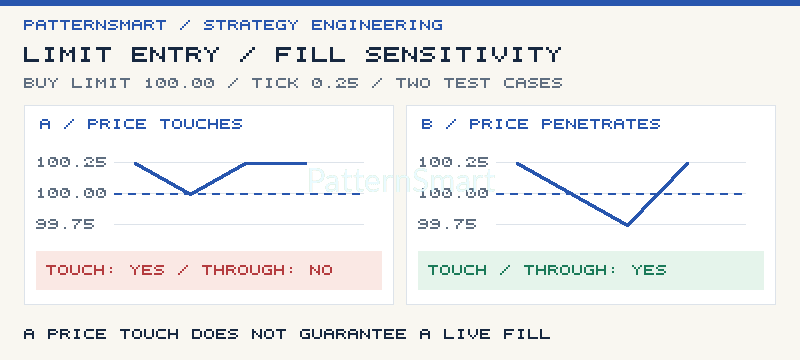
Assume a futures instrument with a tick size of 0.25 and a hypothetical buy limit at 100.00, already working before either price path begins. In case A the traded price falls to 100.00 and rebounds. In case B it trades at 99.75 before recovering. A simple touch model may count both entries; a one-tick penetration rule rejects A and accepts B, assuming the order was active and the relevant price data and fill settings support that decision.
| Scenario | Lowest trade | Touch model | One-tick penetration test |
|---|---|---|---|
| A | 100.00 | Eligible | Not eligible |
| B | 99.75 | Eligible | Eligible |
Eligibility in a historical model is not a promise of execution. Queue priority, available size, latency, cancellation and the actual routing venue can all affect live results.
Build a controlled PowerLanguage entry
The following illustrative signal calculates a breakout using the highs of the preceding completed bars and places a next-bar pullback limit four ticks below the signal close. For example, a close of 101.00 yields 100.00 when the tick size is 0.25. Use sufficient historical bars and valid instrument specifications. This fragment assumes a positive tick size, a tick-aligned close and bar-close calculations; it omits protective exits and is not a complete deployable strategy.
Inputs: Lookback(20), PullbackTicks(4);
Vars: TickSize(0), BreakoutLevel(0), LimitPrice(0);

TickSize = MinMove / PriceScale;
BreakoutLevel = Highest(High[1], Lookback);
LimitPrice = Close - PullbackTicks * TickSize;

If MarketPosition = 0 and Close > BreakoutLevel then
    Buy ("PullbackLE") next bar at LimitPrice limit;

// Illustrative entry only. Integrate independent exits.
// Compare fill assumptions in Strategy Properties.
Integrate the order into the existing signal rather than adding a duplicate entry path. A next-bar price order is evaluated for the next bar under the chosen strategy calculation and order settings; repeated signals may generate new requests. Monitor actual working orders and cancellation acknowledgements during automation. Never infer a live position from a historical low crossing the limit.
Run a controlled fill-assumption comparison
- Freeze the chart symbol, session, historical range, order size, stop and target rules, commissions and slippage.
- Review the limit-order execution assumptions in MultiCharts Strategy Properties. Record the exact setting used, including the relevant penetration requirement where supported. Compare touch-based execution with a stricter setting.
- Use Bar Magnifier or tick data when available to improve the timing evidence. Confirm how the selected resolution interacts with the limit-fill assumption; do not assume every configuration applies the same rule.
- Export trade lists and compare the number of entries, entry prices, average net trade, drawdown and missed fills. Match by signal time, not simply trade number.
- Test sensitivity across different market regimes and compare simulated live orders with actual broker acknowledgements and fills.
Interpret the difference
If 100 signals produce 70 simulated entries under a permissive model and 45 under a stricter model, the 25-entry difference deserves investigation. It does not mean that all 25 would fail live, nor that the stricter model is necessarily an exact forecast. The aim is to identify strategies whose profitability depends on fragile fill assumptions. Keep the order logic fixed while changing the execution model, then inspect both missed winners and avoided losers.
Limit orders control the acceptable price, not the probability of execution. A strategy can miss an entire move, receive partial fills or suffer adverse selection. Protective exits, broker-side controls and realistic transaction costs remain necessary.
Official references: Limit Order Execution Assumptions and Bar Magnifier.
This educational excerpt has not been compiled or backtested here. Trading involves risk of loss.
To adapt this free strategy idea to your own trading rules, contact us about Custom MultiCharts strategy Development Services.