The opening range breakout (ORB) is an intraday analytical framework that converts the first part of a trading session into fixed support and resistance references. Its appeal is simplicity: observe the opening range, wait until it is complete, and evaluate subsequent price action against its boundaries. But a breakout of an unfinished range is not the same signal as a breakout of a completed one. This distinction matters when interpreting charts and when comparing historical tests with real-time alerts.
1. Define the opening range before looking for a signal
Choose a session start S and a duration D, such as 15 minutes. Use trades or bars entirely within the half-open interval [S, S+D), assigning boundary trades consistently with the exchange and data provider. Let H be the maximum high and L the minimum low during that interval. Range width W = H − L; midpoint M = (H + L)/2. Once the interval ends and its final bar is confirmed, freeze H and L until the next session.
For close-based confirmation, a completed subsequent bar qualifies as an upside breakout if its close is strictly greater than H, or a downside breakout if its close is strictly less than L. Equality is a touch, not a strict breakout. To count a crossing rather than every close outside the range, also require the preceding close to be at or below H for an upside event, or at or above L for a downside event. Specify whether multiple attempts per session are allowed.
2. Worked example: a 15-minute opening range
Assume an illustrative session begins at 09:30 exchange-local time. The chart uses 5-minute bars labeled by their closing times. These invented values are for teaching, not historical market observations.
| Bar close | Open | High | Low | Close |
|---|---|---|---|---|
| 09:35 | 100 | 102 | 99 | 101 |
| 09:40 | 101 | 104 | 100 | 103 |
| 09:45 | 103 | 105 | 102 | 104 |
The first three bars establish H = 105, L = 99, W = 6 and M = 102 at 09:45. The first subsequent bar closes at 09:50. Notice that the 09:45 close of 104 belongs to the range-building phase; it cannot itself serve as a post-range breakout.
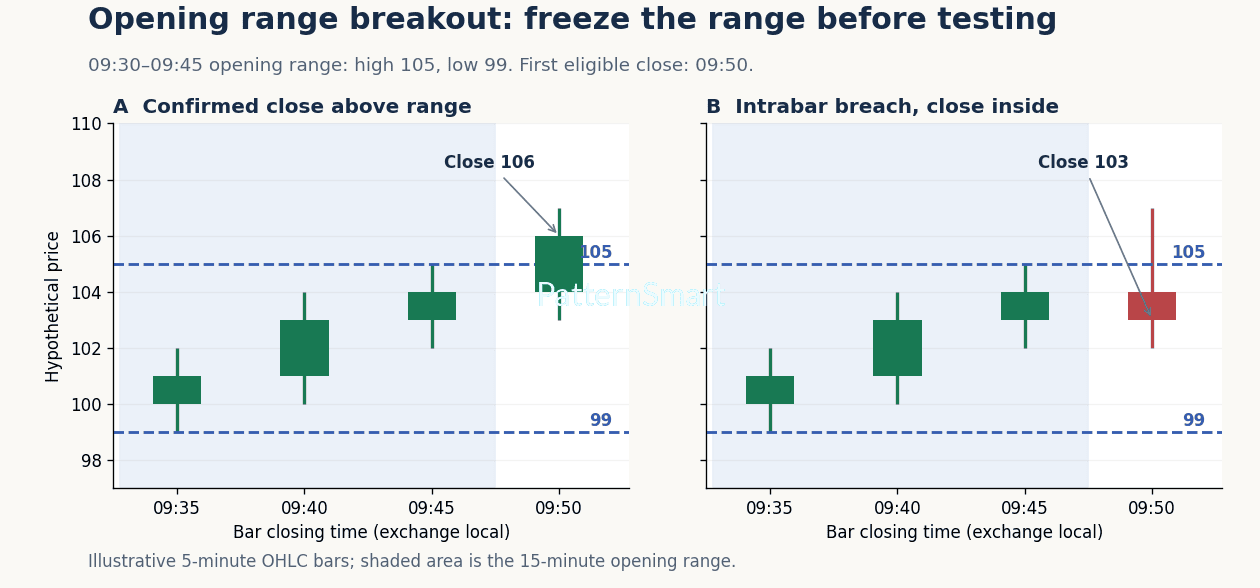
| 09:50 scenario | Open | High | Low | Close | Close-based result |
|---|---|---|---|---|---|
| A | 104 | 107 | 103 | 106 | Upside breakout |
| B | 104 | 107 | 102 | 103 | No breakout |
Both scenarios trade above 105 intrabar, but only A finishes outside. An intrabar stop-entry strategy could trigger in either case; it is a different strategy with different execution assumptions. Even scenario A may subsequently reverse, so confirmation does not guarantee continuation.
3. Separate the signal, entry and invalidation
Consider scenario A with a hypothetical next-bar execution at 106.5, a planned stop at 104.5, and a target at 110.5. The initial risk is 2 price units, and the potential reward is 4 units, giving a 2:1 gross reward-to-risk ratio. For an instrument worth $10 per price unit per contract and an illustrative $100 risk budget, the theoretical maximum is floor(100/(2 × 10)) = 5 contracts before costs and gap risk. Actual loss can exceed the planned stop distance. A stop beneath the entire opening range instead would be considerably wider and require a different size.
A close back inside the frozen range can be defined as a failed-breakout exit rule. A retest of 105 followed by a fresh close above it is another possible confirmation, but waiting may increase entry distance or miss a move. A width projection of H + W = 111 is a reference, not a guaranteed target. Define the chosen rule before testing, rather than selecting it after seeing the outcome.
4. Time alignment is part of the trading rule
Session opening times depend on the instrument, exchange calendar, holidays and session template. Avoid using a computer's local clock as a substitute for exchange-local timestamps. Reset the range once per intended session, not automatically at midnight. Confirm whether the data vendor labels bars by start or end time: a bar labeled 09:45 might represent either 09:40–09:45 or 09:45–09:50. For a chart interval that straddles the range boundary, reconstruct the range using finer data or choose aligned intervals; do not silently include post-range prices.
If opening bars are missing because of a data outage, flag the session as incomplete rather than manufacturing a high or low. For continuous markets, choose an explicit reference session; there is no universal opening window. Changes in exchange daylight saving rules or shortened sessions should be handled through the calendar.
5. Validate an ORB hypothesis without hindsight
Test 15-minute and 30-minute windows separately on chronological training and holdout data. Log range completion time, H, L, signal timestamp, entry fill, exit and costs. A close-confirmed signal must not assume a fill at a price available before the signal. If stop and target are both touched within one OHLC bar, use finer execution data or a documented conservative rule. Include commission, spread, slippage and missed fills.
Compare results across narrow and wide opening ranges, volatile and quiet sessions, and different trading hours. An optional range-width filter can be expressed as W divided by a prior completed volatility estimate; calibrate it only on training data. Evaluate net expectancy, drawdown and trade count, not just win rate. A small sample or an optimized time window does not establish a durable edge.
Key takeaway
ORB supplies fixed reference levels, not a prediction. Keep the range-building phase separate from the signal phase, and use the same clock, confirmation and execution assumptions in historical and live analysis. For customized range indicators, alerts or strategy-testing tools, explore our Custom Trading Software Development Services.
Risk disclaimer: Educational content only, not investment advice. Hypothetical examples exclude certain real-world execution uncertainties. Trading can result in substantial losses; no indicator or breakout rule guarantees profitability.