While many traders obsess over identifying market reversals, the most consistent profits are often found by trading in the direction of the dominant trend. The Rising Three Methods is a premier five-candle bullish continuation pattern that offers a highly reliable signal that an existing uptrend has briefly paused to absorb supply before resuming its upward trajectory.
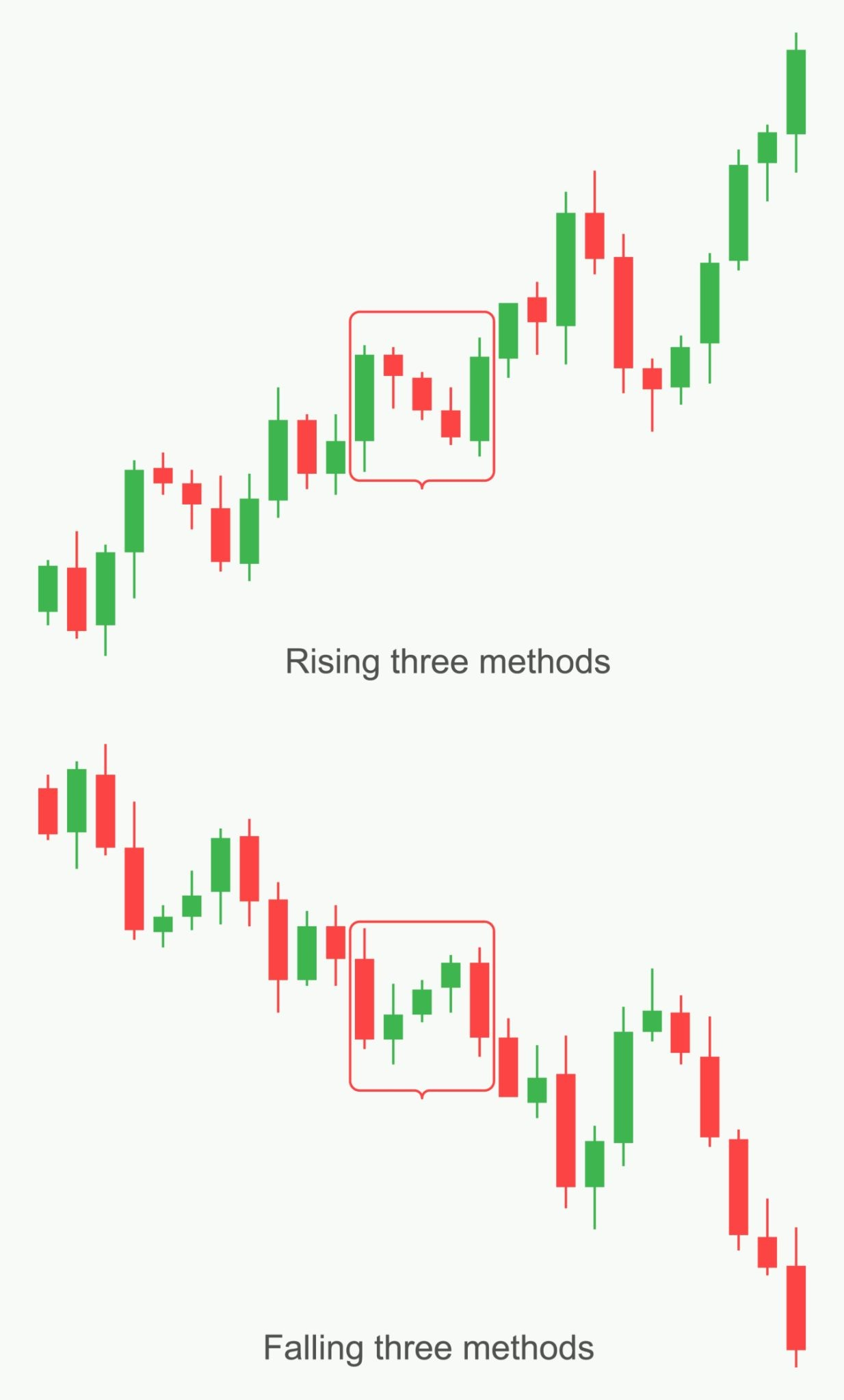
Anatomy of the Rising Three Methods
The structural validity of the Rising Three Methods relies on a precise sequence of five distinct candlesticks developing within an established uptrend.
       [Uptrend]
          |
         | |                       | | -> Candle 5: Large Green Body
         | |       | |   | |   | | | |    (Closes above Candle 1 High)
         | |       | |   | |   | | | |
         | |       \ /   \ /   \ / \ /
       Candle 1    -------------------
     (Large Green)  Candles 2, 3, 4
                   (Small Red Pullback)
- Candle 1 (The Anchor): A long, bullish (green/white) candlestick that prints during a strong uptrend, reinforcing the dominant control of the buyers.
- Candles 2, 3, and 4 (The Rest Phase): A group of three consecutive, small-bodied bearish (red/black) candlesticks that slope downward.
- Critical Rule: The entire bodies of these three smaller candles must remain within the high-to-low range of Candle 1. They represent a shallow, orderly pullback rather than a structural breakdown.
- Candle 5 (The Resumption): A powerful, large bullish candlestick that opens near the close of Candle 4 and rallies strongly, ultimately printing a closing price that exceeds the closing price of Candle 1.
Market Psychology: Orderly Profit-Taking vs. Institutional Accumulation
To understand the predictive power of this pattern, we must look at the shifting order flow and participant psychology behind the scenes:
- The Anchor (Candle 1): Bulls are in full control. Momentum is strong, and institutional buying is driving the asset to local highs.
- The Intermission (Candles 2–4): Following a steep advance, short-term traders begin booking profits. This creating a shallow decline. However, notice the defining characteristic: the pullback is weak. The fact that three full sessions of selling cannot breach the low of a single day’s buying indicates a profound lack of distribution (selling pressure). Smart money is not dumping shares; they are simply stepping back to let the market rest.
- The Breakout (Candle 5): Seeing that the pullback failed to attract significant supply, institutional buyers step back in aggressively. Short-sellers who attempted to pick a top are trapped as the price surges, forcing them to cover. The strong close above Candle 1 confirms that the correction is over and the path of least resistance remains up.
Technical Integration & Filtering
To avoid false signals in noisy markets, professional technical analysts filter the Rising Three Methods through volume analysis and momentum indicators:
1. The Volume Profile
Volume should act as a clear confirmation mechanism for the pattern:
- Candle 1 should print on high volume, confirming institutional expansion.
- Candles 2, 3, and 4 should exhibit steadily declining volume. Low volume on a pullback is clear evidence that the selling is retail profit-taking, not institutional distribution.
- Candle 5 must see a sharp resurgence in volume, proving that big money has re-entered to drive the breakout.
2. Algorithmic Scanning Filter
When building quantitative filters for platforms like NinjaTrader or custom scripts, you can formalize the pattern’s boundaries using a strict condition array:
$$\text{Low}_{(\text{Candles } 2,3,4)} > \text{Low}_{(\text{Candle } 1)}$$
$$\text{High}_{(\text{Candles } 2,3,4)} < \text{High}_{(\text{Candle } 1)}$$
$$\text{Close}_{(\text{Candle } 5)} > \text{Close}_{(\text{Candle } 1)}$$
Strategic Trading Blueprint
The Rising Three Methods provides an exceptional risk-to-reward profile because the pattern itself marks out exact support and invalidation levels.
1. Trade Entry Execution
- Aggressive Trigger: Enter a long position on the live close of Candle 5, once it is clear the price will settle above the close/high of Candle 1.
- Conservative Trigger: Place a buy-stop order slightly above the high of Candle 5 during the next session, ensuring immediate follow-through momentum.
2. Stop-Loss Placement
- Primary Stop-Loss: Position your protective stop just below the low of Candle 1. If the market falls below this anchor candle, the bullish continuation thesis is completely invalidated.
- Tight Stop-Loss: For higher-leverage setups, the stop can be adjusted to sit just below the lowest tail of the pullback (typically Candle 4).
3. Take-Profit Targets
Because this is a continuation pattern, the next leg up frequently mirrors the velocity and length of the prior advance.
- Use Fibonacci Extensions (projecting the $1.618$ or $2.618$ extension of the primary trend leg).
- Alternatively, apply a measured move approach: calculate the distance from the start of the trend leg to the high of Candle 1, and project that same distance upward from the low of Candle 4.
Summary for the Modern Trader
The Rising Three Methods is highly reliable because it prevents traders from chasing extended markets. Instead, it systematically identifies an optimal, low-risk entry point within an existing trend. By demanding that the three-day pullback remain confined within the range of the initial impulse wave, this pattern ensures you only deploy capital when the broader trend is pausing to catch its breath—right before it runs higher.
Please check our Bullish Patterns Indicator collection.