In institutional algorithmic trading and quantitative development, maintaining a strict separation of concerns between data analysis and order execution is paramount. Within the NinjaTrader 8 ecosystem, this architectural boundary is defined by two primary NinjaScript classifications: Indicators and Strategies.
While both components leverage C# and inherit from the foundational NinjaTrader.NinjaScript.NinjaScriptBase class, they serve completely divergent operational purposes. Misunderstanding these differences frequently leads to brittle code, execution errors, and flawed backtesting models.
Executive Summary: Analysis vs. Execution
The fundamental distinction between a NinjaTrader indicator and a strategy can be synthesized into a single operational rule: Indicators analyze the market; strategies transact within it.
- Indicators are deterministic mathematical models designed to transform raw market data (price, volume, order flow) into visual or numerical outputs. They operate in a read-only capacity relative to the broker’s order routing system.
- Strategies are decision-making and execution engines. They consume market data—often utilizing indicators as inputs—to run logic that programmatically generates, modifies, and cancels orders, managing the entire lifecycle of a trade.
1. NinjaTrader Indicators: The Analytical Layer
An Indicator (NinjaTrader.NinjaScript.Indicators.Indicator) is designed exclusively for technical analysis and data visualization. Its primary objective is to compute values based on historical and real-time data streaming into a chart or script.
Key Functional Characteristics
- Data Rendering: Indicators possess direct access to the chart’s rendering engine. They can plot data points via
Series<double>objects, paint bars, or draw geometric shapes and text directly onto the UI panel. - Zero Execution Capability: By architectural design, an indicator lacks the native methods required to interact with the NinjaTrader core execution engine. It cannot call order functions like
EnterLong()orExitShort(), nor can it view account balances, open positions, or execution histories. - Multi-Timeframe Scope: Indicators can be applied across various intervals, but their calculation loop typically binds to the primary data series of the chart panel they inhabit.
Common Institutional Use Cases
Institutional desks deploy indicators to calculate proprietary alpha factors, evaluate market volatility thresholds (e.g., customized Average True Range variants), or parse order book imbalances using Level 2 data.
2. NinjaTrader Strategies: The Execution Layer
A Strategy (NinjaTrader.NinjaScript.Strategies.Strategy) is an automated trading system. It represents a programmatic framework capable of evaluating entry and exit conditions, processing risk management parameters, and routing live orders to an electronic broker.
Key Functional Characteristics
- Order Routing and Lifecycle Management: Strategies are equipped with specialized execution methods such as
SubmitOrderUnmanaged()or managed alternatives likeEnterLongLimit(). They maintain a direct state link to the NinjaTrader trade engine, tracking fills, partial fills, working orders, and rejections. - Position State Awareness: Unlike indicators, a strategy actively monitors portfolio variables. It understands the strategy’s current position size, average entry price, and unrealized profit and loss (P&L).
- Analytical Integration: Strategies do not need to recalculate basic mathematics natively. Instead, they can instantiate and reference indicators directly within their code to serve as data filters or execution triggers.
Common Institutional Use Cases
Strategies are used for executing systematic portfolios, such as mean-reversion systems, trend-following algorithms, or statistical arbitrage models that require programmatic precision and minimal latency.
3. Technical Comparison of Core Dimensions
To optimize these tools for both search retrieval and development clarity, it is critical to break down how they diverge across key systems architecture criteria.
Execution Context and Threading
Indicators run predominantly on the user interface (UI) thread to handle real-time rendering smoothly. Overloading an indicator with heavy computational logic can lock the chart display. Strategies, conversely, operate within a high-priority execution context optimized to process incoming ticks (OnMarketData) or bar closes (OnBarUpdate) rapidly, minimizing the path to order submission.
Backtesting and Optimization Capabilities
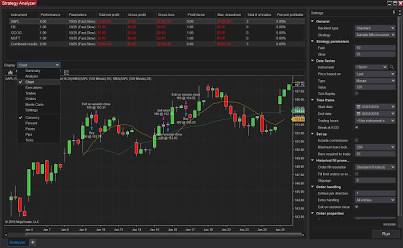
Strategies can be compiled, backtested, and optimized within the NinjaTrader Strategy Analyzer. This module subjects the strategy to historical data, applying precise slippage configurations, commission structures, and high-resolution tick-replay models. Indicators cannot be backtested independently in this manner because they generate no trade performance metrics to analyze.
State Persistence and Recovery
When a strategy restarts or experiences a connection drop, it must handle position synchronization (matching its internal script state with the actual broker allocation). NinjaTrader provides strategies with strict state handling variables like OvernightPlacing and StartBehavior. Indicators do not have or require these mechanisms, as they recalculate their absolute visual state linearly from historical data upon every chart reload.
4. Architectural Best Practices: Nested Implementation
In a well-designed quantitative architecture, indicators and strategies work in tandem rather than competing. The industry-standard pattern involves nesting indicators inside a strategy wrapper.
C#
// Inside a NinjaScript Strategy class
protected override void OnStateChange()
{
    if (State == State.Configure)
    {
        // Instantiate the indicator within the strategy allocation phase
        exponentialMovingAverage = EMA(Close, 20);
    }
}

protected override void OnBarUpdate()
{
    // Evaluate the indicator's analytical output to drive execution logic
    if (Close[0] > exponentialMovingAverage[0])
    {
        EnterLong("EMA_Cross");
    }
}
By decoupling the mathematical logic (the EMA indicator) from the execution rules (the long entry order), developers can independently optimize, debug, and reuse the indicator code across multiple unrelated automated strategies.