The Marubozu is one of the most powerful and straightforward single-candle formations in technical analysis. Translated from Japanese, Marubozu means “bald head” or “shaved head”—a literal reflection of the candle’s defining visual trait: it has absolutely no wicks (shadows), or at most, incredibly minor ones.
When a Marubozu prints on a chart, it indicates an uncompromising, relentless surge of market conviction. One side of the market seized control at the opening bell and did not surrender it for a single moment until the session closed.
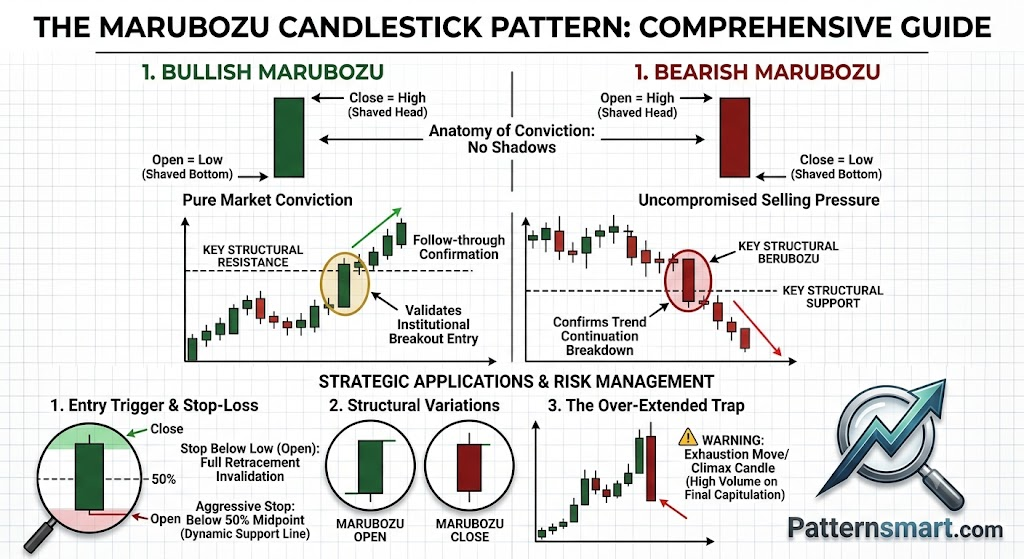
Anatomy of a Marubozu
The structural definition of a pure Marubozu is mathematically rigid. The open and close are perfectly equal to the absolute high and low of the session.
1. The Bullish Marubozu (Green/White)
- Mathematical Rule: $\text{Open} = \text{Low}$ and $\text{Close} = \text{High}$
- Visual Profile: A long, solid green body with completely flat tops and bottoms.
- Meaning: From the opening second, buyers flooded the market. Sellers were entirely incapable of pushing the price below the opening price. The buying momentum intensified throughout the session, closing at the absolute peak of the period.
2. The Bearish Marubozu (Red/Black)
- Mathematical Rule: $\text{Open} = \text{High}$ and $\text{Close} = \text{Low}$
- Visual Profile: A long, solid red body with no upper or lower wicks.
- Meaning: Aggressive supply dominated the market immediately upon opening. Buyers could not force a rally above the open, and the intense liquidation forced the price down to close at its dead low.
The Market Psychology Behind the Real Body
Most candlestick patterns represent a tug-of-war—wicks showcase failed attempts to break levels, indicating hesitation or absorption. The Marubozu is the complete opposite of hesitation; it is the visual depiction of a one-sided market sweep.
- No Upper Shadow (Bullish): Shows that even at the very last second of trading, buyers were still actively clearing out supply at premium prices. There was zero end-of-session profit-taking.
- No Lower Shadow (Bearish): Proves that panicking longs or aggressive short-sellers were relentlessly hitting the bid all the way until the closing bell rang.
Strategic Trading Applications: Reversals vs. Breakouts
A Marubozu can serve as either a continuation signal or a trend reversal, heavily dependent on where it appears within the broader market structure.
1. The Key Resistance Breakout
When an asset is consolidating under a major multi-test horizontal resistance level, a Bullish Marubozu slicing through that level is the ultimate confirmation of an institutional breakout. It signals that large-scale players are comfortable buying the asset at a premium, validating a high-probability long entry.
2. Risk Management & Stop-Loss Rules
Because a Marubozu represents a massive expansion in volatility, the candle body itself forms your baseline risk parameter:
- The Stop-Loss Level: For a long position triggered by a breakout Marubozu, the stop-loss is technically set just below the 100% retracement level of the candle (the Open/Low).
- The 50% Rule (Alternative): In cases where the Marubozu body is exceptionally large, setting a stop below the open results in poor risk-to-reward ratios. Professional traders often treat the exact 50% midpoint of a Marubozu’s real body as a dynamic support line. A violation of the candle’s midpoint means the initial breakout momentum has failed.
3. Structural Variations
In live trading, a perfectly “shaved” candle is quite rare. Technical analysis recognizes two valid, high-potency variations:
- Marubozu Open: Has a completely flat open (no wick at the opening end) but a tiny wick at the close, indicating a minor pause at the finish line.
- Marubozu Close: Features a tiny wick at the open, but closes exactly at its high/low extreme, proving the session ended with maximum strength.
Pitfalls: The Over-Extended Trap
The primary risk when trading a Marubozu is the exhaustion move. If a massive Marubozu prints after an asset has already rallied or plummeted for several consecutive days, it is often a “climax candle” (buying or selling climax).
In this scenario, the Marubozu represents the final capitulation of weak retail hands chasing the trend or shorts covering in a panic. Always check volume: a valid continuation Marubozu should be backed by a substantial relative volume spike, whereas an exhausted climax candle often leaves a vacuum of volume in the subsequent sessions.
Please check our Bearish and Bullish Patterns Indicator collection.