The Three Outside Up is a highly reliable, three-candle bullish reversal pattern that serves as a powerful validation of market structure shifts. While a standard two-candle Bullish Engulfing pattern flags early aggressive buying, the Three Outside Up adds a crucial third confirmation session. This sequence signals that institutional supply has been thoroughly absorbed and that a new, sustainable uptrend is underway.
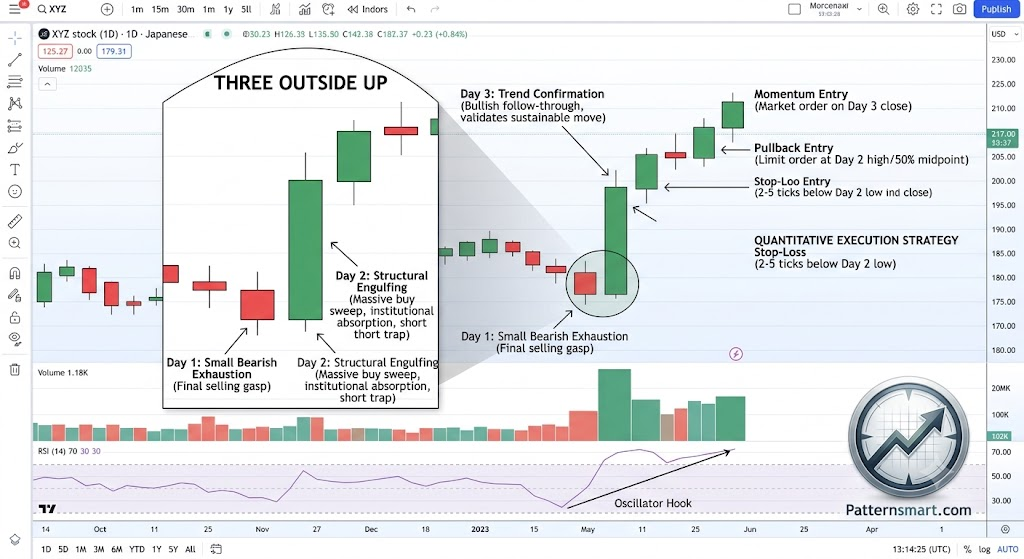
Anatomy of the Pattern
The pattern consists of three distinct candles that develop at the tail end of a structural downtrend:
- Candle 1 (The Bearish Exhaustion): A small bearish candle that continues the prevailing downtrend. It represents the final, weakening gasp of selling pressure.
- Candle 2 (The Structural Engulfing): A large, high-volume bullish candle. Crucially, its real body must completely engulf the real body of Candle 1 from open to close. This aggressive price action invalidates the previous session’s sellers and demonstrates an immediate demand imbalance.
- Candle 3 (The Trend Confirmation): A solid bullish candle that closes completely above the high of Candle 2. This session provides the final quantitative validation, proving that the momentum generated on the second day has follow-through and isn’t just a transient short-covering squeeze.
Market Psychology & Order Flow Dynamics
Looking under the hood at the order book reveals how this pattern systematically traps shorts and builds long inventory:
- Passive Liquidity Trap (Candle 1): The market drifts lower on lower relative volume. Retail shorts continue to press the trend, unaware that they are selling directly into a dense pocket of institutional passive buy limits.
- Aggressive Demand Sweep (Candle 2): Large-scale algorithmic buyers aggressively sweep the ask, lifting prices rapidly. As the body completely engulfs the prior session, a massive cluster of trailing stop-losses from short positions is triggered, fueling the upward velocity. The bears are caught completely off guard.
- Institutional Follow-Through (Candle 3): Many traders worry that an engulfing candle represents an “overextended” move. Candle 3 resolves this ambiguity. By opening steady and pushing past Candle 2’s high, it confirms that institutions are comfortable buying at these higher valuations and are actively defending the newly formed structural floor.
Quantitative Execution Strategy
Because the Three Outside Up relies on a clear momentum breakout on the final session, systematic trading models can execute this pattern with well-defined risk parameters.
Confirmation and Entry Metrics
| Component | Tactical Action | Notes |
| Momentum Entry | Market order executed immediately upon the close of Candle 3. | High-conviction entry; ensures you do not miss a rapidly accelerating breakout. |
| Pullback Entry | Limit order placed at the high or 50% midpoint of Candle 2. | Aims to catch a micro retest of the initial engulfing breakout zone for a tighter risk-to-reward ratio. |
| Stop-Loss Placement | Placed 2–5 ticks below the absolute low of Candle 2. | If the market invalidates the low of the engulfing bar, the structural bullish thesis is broken. |
Maximizing Expectancy with Technical Confluence
- Volume Progression: For optimum expectancy, volume should expand noticeably on Candle 2 and maintain above-average levels on Candle 3. A breakout on thin volume hints at an unreliable “fakeout.”
- Oscillator Hook: Look for the pattern to trigger precisely as a 14-period Relative Strength Index (RSI) or Stochastic Oscillator crosses back above its oversold threshold ($>30$). Ideally, Candle 1 or 2 should print a higher low on the oscillator compared to a previous structural swing low, flashing a classic bullish divergence.
- Moving Average Clean Break: The validity of this reversal increases dramatically when Candle 3 closes above a declining short-term exponential moving average (such as the 9 EMA or 21 EMA), effectively shifting the immediate dynamic trend from bearish to bullish.
Please check our Bullish Patterns Indicator collection.