The Unique Three River Bottom is a rare, three-candle bullish reversal pattern that typically forms at the end of a mature downtrend. While many traders are familiar with standard triple-candle patterns like the Morning Star or Three White Soldiers, the Unique Three River Bottom offers a more nuanced look at a market shifting from aggressive liquidation to institutional accumulation.
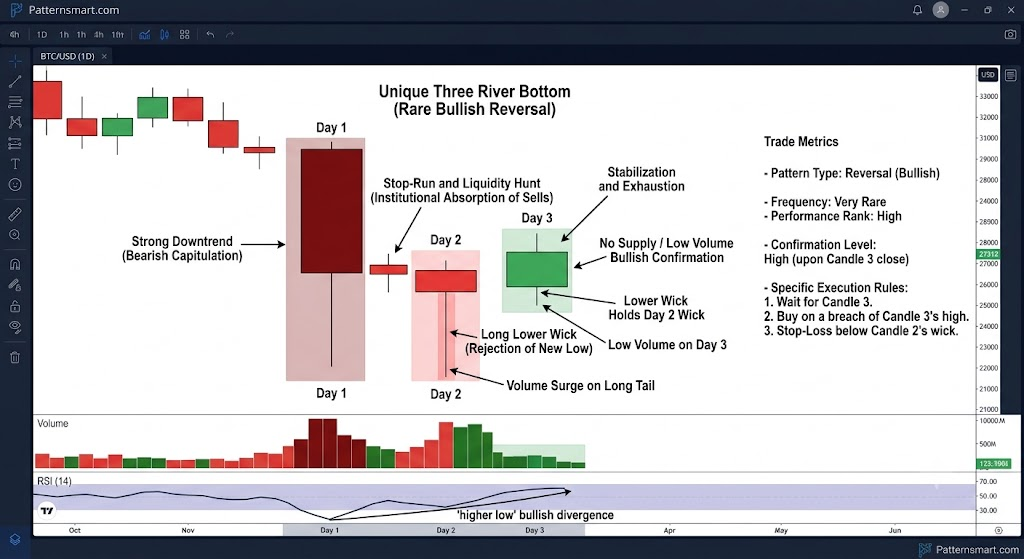
Anatomy of the Pattern
The pattern is defined by strict structural rules across three consecutive sessions:
- Candle 1 (The Trend Extension): A large bearish candle (frequently a Closing Black Marubozu) that extends the prevailing downtrend. This represents strong, capitulatory selling volume.
- Candle 2 (The Liquidity Hunt): A bearish candle that opens within or below the first candle’s body. Crucially, it features a long lower shadow that makes a fresh low, piercing beneath the support of Candle 1. However, the price recovers before the close, leaving a short real body.
- Candle 3 (The Exhaustion Sign): A short, stable bullish candle. This candle must stay completely within or below the body of the second candle, and its low must fail to breach the lower shadow of Candle 2.
Market Psychology Behind the Order Flow
Understanding the structural mechanics of this pattern requires looking at the shifting balance between supply and demand imbalances:
- Bearish Capitulation (Candle 1): The sellers are fully in control. Price accelerates downward, trapping late shorts and forcing stops on older long positions.
- The Stop-Run and Absorption (Candle 2): Sellers attempt to push the market significantly lower, triggering a cluster of sell-stop orders below the recent swing lows. Institutional buyers utilize this pocket of high sell-side liquidity to absorb the orders and build long inventory. The aggressive bounce off the lows creates the prominent lower wick, signaling that supply is drying up.
- Stabilization & Lack of Supply (Candle 3): The final candle confirms that selling pressure has been completely exhausted. Sellers no longer have the momentum to test the liquidity pool established by the second candle’s wick. The small bullish body indicates that even minor buy-side pressure can now shift the market structure upward.
Quantitative Execution Strategy
Because this pattern is exceptionally rare in its purest form, mechanical traders often track it via quantitative scanning rules based on relative candle heights and wick-to-body ratios.
Conformation and Entry Metrics
| Component | Tactical Action | Notes |
| Trigger Entry | Limit order at the close of Candle 3 or a market order upon a breach of Candle 3’s high. | Immediate entries are high risk without a volume or oscillator divergence filter. |
| Stop-Loss Placement | Placed strictly 2–5 ticks below the lowest point of Candle 2’s lower shadow. | If the market invalidates this level, the accumulation thesis fails completely. |
| Conservative Alternative | Wait for a 4th confirmation candle to close above the highest open/close of the 3-candle cluster. | Reduces the win-rate-to-risk ratio but significantly improves accuracy. |
Maximizing Performance with Confluence
To separate highly accurate setups from false bottoms, look for the following auxiliary technical signals:
- Volume Divergence: Candle 1 should exhibit high relative volume. Candle 2 should see a surge on the wick formation (signaling absorption), while Candle 3 should see dropping volume, confirming selling exhaustion.
- Oscillator Oversold Reversals: The pattern yields the highest expectancy when it prints while a fast momentum indicator (like a 14-period Relative Strength Index or Williams%R) is emerging from oversold territory ($<30$ or $<-80$), ideally printing a higher low relative to the price’s lower low on Candle 2.
- Key Support Confluence: The long tail of Candle 2 should reject a major structural daily or weekly level, such as a historical support zone, an institutional order block, or a key Fibonacci retracement level.
Please check our Bullish Patterns Indicator collection.