The Three White Soldiers is one of the most powerful and reliable bullish reversal patterns in technical analysis. While single-candle formations like hammers provide early hints of a shift in market structure, this strong three-candle sequence offers definitive proof that institutional accumulation has begun and that the bulls have seized total control of price action.
Please check our Bullish Patterns Indicator collection.
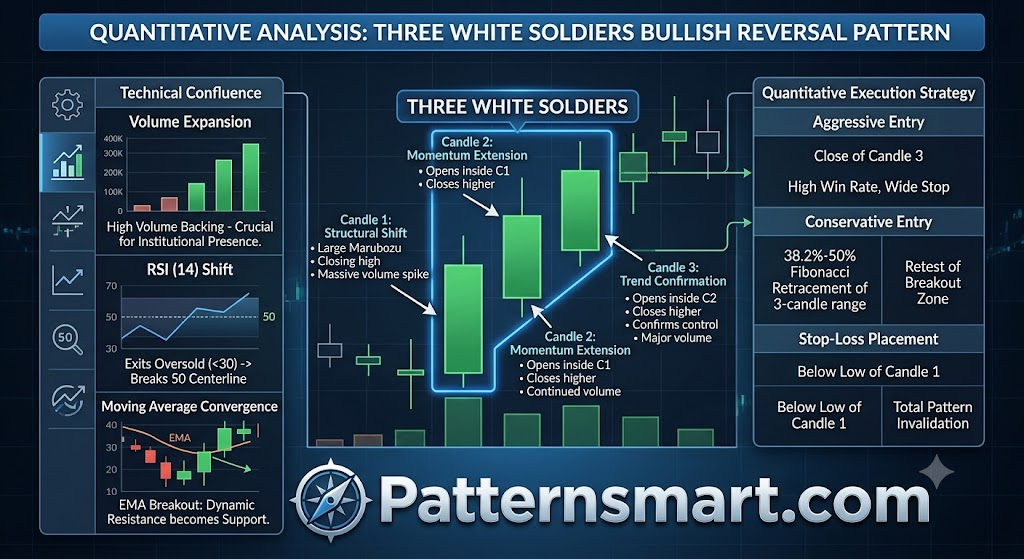
Anatomy of the Pattern
The pattern is defined by strict structural rules across three consecutive sessions, indicating sustained, uninterrupted buying pressure:
- Candle 1 (The Structural Shift): Following a distinct downtrend, a strong bullish candle prints. This is often a large green (or white) Marubozu or near-Marubozu, closing near its absolute high. It represents an aggressive rejection of the prior bearish trend.
- Candle 2 (The Momentum Extension): Another strong bullish candle forms. Crucially, it must open within the real body of Candle 1 (indicating a slight pull-back or flat open rather than an exhaustive gap-up). It then extends upward to close higher than Candle 1, maintaining a small upper wick.
- Candle 3 (The Trend Confirmation): The final bullish candle completes the pattern. Like the previous session, it opens within the real body of Candle 2 and marches higher, closing above Candle 2’s high. This candle confirms that the buying pressure is sustainable and not a brief short-covering bounce.
Market Psychology & Order Flow Dynamics
To trade this pattern effectively, you must understand the shifts occurring within the order book during its formation:
- The Reversal Pivot (Candle 1): The market hits a liquidity pocket where sell orders dry up and institutional buy orders sweep the offer. This sudden demand imbalance forces a strong close near the highs, trapping late shorts and triggering the stop-losses of early momentum sellers.
- Sustained Institutional Accumulation (Candle 2): Instead of profit-taking causing a deep retracement, institutional algorithms continue to actively accumulate shares or contracts. By opening inside the previous day’s body and pressing higher, it shows that buyers are willing to absorb any residual selling pressure without letting the price collapse back down.
- Bearish Capitulation (Candle 3): The final candle forces any remaining bears to cover their positions out of necessity, creating an upward feedback loop. The lack of major upper wicks across all three sessions underscores that the market is closing at the point of maximum demand, signaling a clean structural breakout.
Quantitative Execution Strategy
Because the Three White Soldiers pattern covers a significant distance over three periods, the primary risk for quantitative traders is entering a market that is temporarily overextended.
Confirmation and Entry Metrics
| Component | Tactical Action | Notes |
| Aggressive Entry | Market order placed immediately at the close of Candle 3. | High win rate, but requires a wider stop-loss due to the vertical move. |
| Conservative Entry | Limit order placed at a 38.2% to 50% Fibonacci retracement of the entire 3-candle range. | Aims to catch the first structural retest of the breakout zone. |
| Stop-Loss Placement | Placed 2–5 ticks below the low of Candle 1. | If price retraces completely below the start of the pattern, the reversal is invalidated. |
Maximizing Expectancy with Technical Confluence
To protect against false breakouts (often caused by low-volume short squeezes), overlay these technical filters:
- Volume Expansion: Volume should ideally increase or remain consistently high across all three days. A “Three White Soldiers” pattern forming on declining volume is highly suspect and often indicates a lack of institutional backing.
- Relative Strength Index (RSI) Shift: Look for the pattern to initiate just as the RSI exits an oversold condition ($<30$) and breaks sharply above the 50 centerline. If the third candle pushes the RSI into overbought territory ($>70$), prioritize a conservative entry on a minor pullback rather than buying the immediate close.
- Moving Average Convergence: The validity of the reversal is dramatically enhanced if the third candle pierces and closes above a major structural barrier, such as a declining 20-period Exponential Moving Average (EMA) or a 50-period Simple Moving Average (SMA), turning old dynamic resistance into new support.