Analyze Trend Transitions Through Structured Momentum Confirmation
Markets do not always change direction abruptly. In many cases, a trend begins to lose momentum before the price structure visibly changes. This transition between strengthening and weakening momentum can provide important information for technical analysts.
MACD Double Divergence Pro for MultiCharts applies the PatternSmart Double Divergence methodology to MACD-based trend and momentum analysis. It is designed to help traders identify situations where price movement and MACD behavior begin to diverge, providing additional evidence for evaluating trend transitions, developing trends, and potential changes in market structure.
Rather than treating divergence as a prediction, the methodology uses it as another piece of technical evidence that can be evaluated alongside price action, support and resistance, and broader market context.
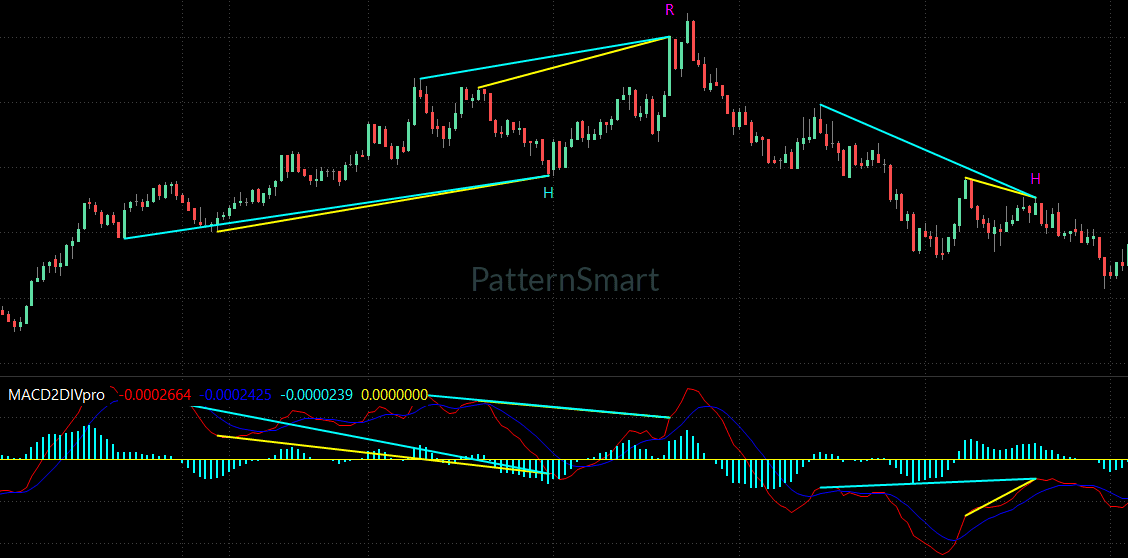
Why MACD Is Valuable for Trend Analysis
The Moving Average Convergence Divergence (MACD) combines moving-average relationships with momentum analysis. This makes it particularly useful for studying how a trend is developing rather than simply measuring an isolated price movement.
MACD analysis can help traders observe:
- Trend momentum
- Momentum acceleration and deceleration
- Developing trends
- Changes in trend behavior
- Potential trend exhaustion
- Medium-term market structure
MACD Double Divergence extends this perspective by examining the relationship between price and MACD behavior.
When price continues moving in one direction while MACD develops differently, the discrepancy can become an important area for further analysis.
The key question is not simply “Is there divergence?”
It is:
“What does the divergence tell us about the current trend, and is there enough additional confirmation to support the interpretation?”
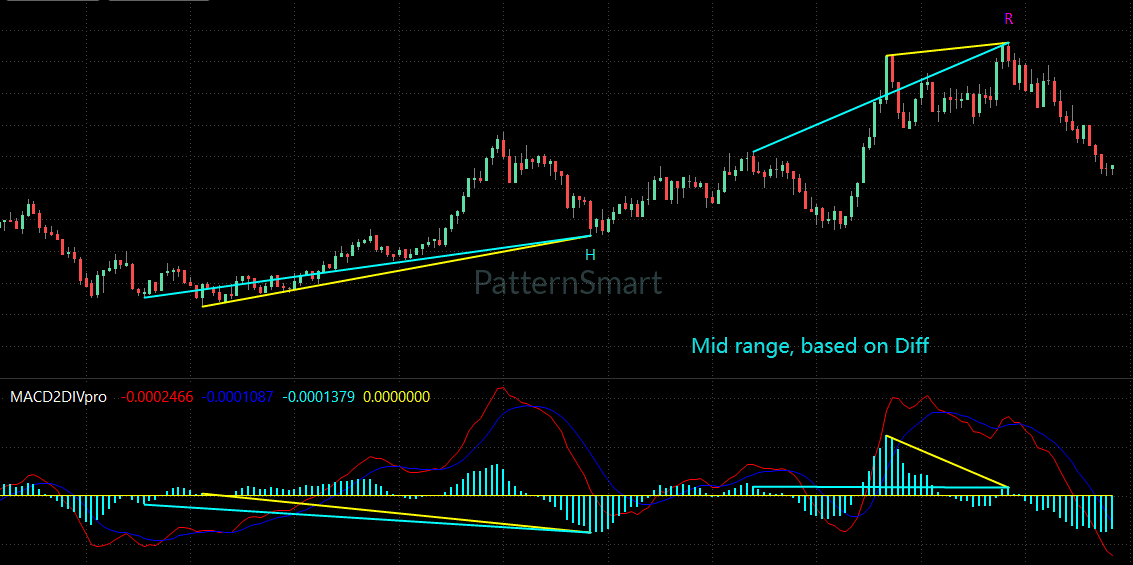
A Confirmation-Based Approach to MACD Divergence
Traditional divergence analysis often focuses on a single comparison between price and an indicator.
The PatternSmart Double Divergence methodology takes a broader approach.
The analytical process can be summarized as:
Observe → Compare → Confirm → Interpret → Evaluate
Price remains the primary source of information. MACD provides an additional perspective on momentum and trend development.
A divergence therefore does not automatically indicate that a reversal will occur. Instead, it identifies a difference between price behavior and indicator behavior that may warrant closer examination.
Additional evidence from market structure, price action, support and resistance, or other technical tools can provide further confirmation.
This confirmation-based philosophy is central to MACD Double Divergence Pro.
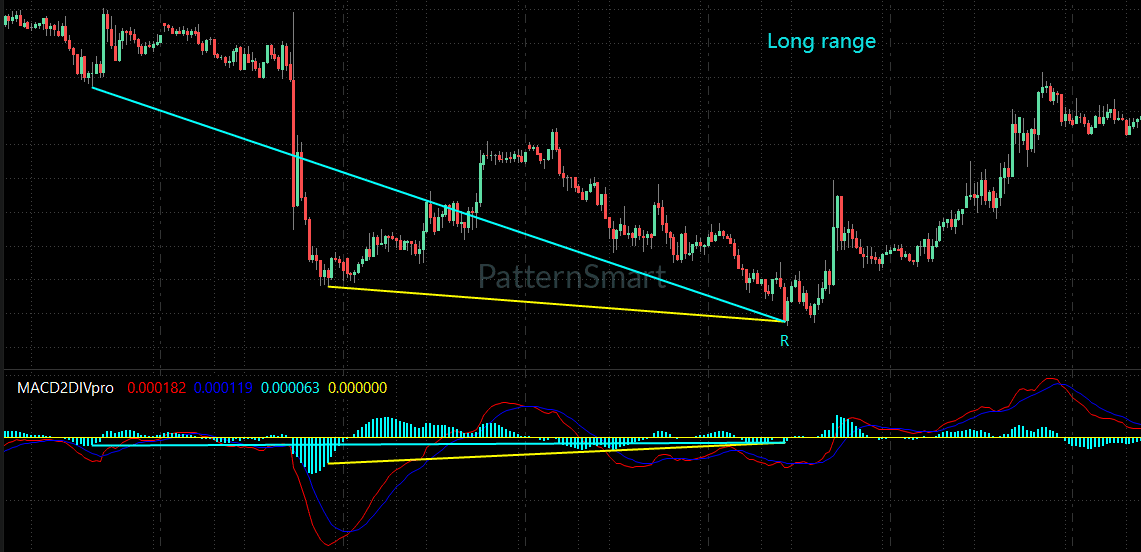
Regular and Hidden Double Divergence
MACD Double Divergence Pro supports both Regular Double Divergence and Hidden Double Divergence, allowing traders to examine different relationships between price structure and MACD behavior.
Regular Bullish Double Divergence
Regular bullish divergence can highlight situations where price continues developing weakness while MACD behavior provides a different momentum perspective.
It can be particularly relevant when evaluating potential changes following an extended decline.
Regular Bearish Double Divergence
Regular bearish divergence examines situations where price continues advancing while MACD momentum develops differently.
This can provide additional information when assessing whether an established upward trend is losing momentum.
Hidden Bullish Double Divergence
Hidden bullish divergence can be useful when evaluating potential trend continuation following a pullback.
Rather than focusing exclusively on reversal conditions, it allows traders to examine whether the underlying bullish structure may remain intact.
Hidden Bearish Double Divergence
Hidden bearish divergence provides the corresponding perspective during bearish market structures, helping analysts evaluate whether a downward trend may retain its underlying momentum following a retracement.
The four signal categories provide different analytical perspectives rather than representing four variations of the same market condition.
Choose the MACD Perspective That Fits Your Analysis
MACD Double Divergence Pro provides multiple Divergence Value Mode choices:
- MACD
- Avg
- Diff
These modes allow the divergence analysis to be based on different MACD-derived values.
This is useful for traders who want to study trend momentum from more than one MACD perspective without changing the underlying Double Divergence methodology.
The distinction is analytical rather than methodological: the same confirmation philosophy remains in place while the underlying MACD information being evaluated changes.
Control the Scope of Divergence Analysis
Professional technical analysis often requires flexibility in how historical market structures are evaluated.
MACD Double Divergence Pro includes several parameters for this purpose.
Divergence Bar Range
Divergence Bar Range controls the structural search range used when identifying potential divergence anchor points.
Available choices include:
- ShortRange
- MidRange
- LongRange
Smaller ranges focus the structural search on relatively shorter-term relationships, while broader ranges allow larger historical structures to be evaluated.
Divergence Lookback
Divergence Lookback controls the historical range used when identifying relevant swing points.
This gives traders control over the scope of the structural analysis without changing the underlying Double Divergence methodology.
Filter Length
Filter Length influences the internal smoothing used during structural evaluation.
Together, these parameters provide a structured way to study how different historical structures affect divergence analysis.
They should be understood as analytical configuration tools rather than separate trading methodologies.
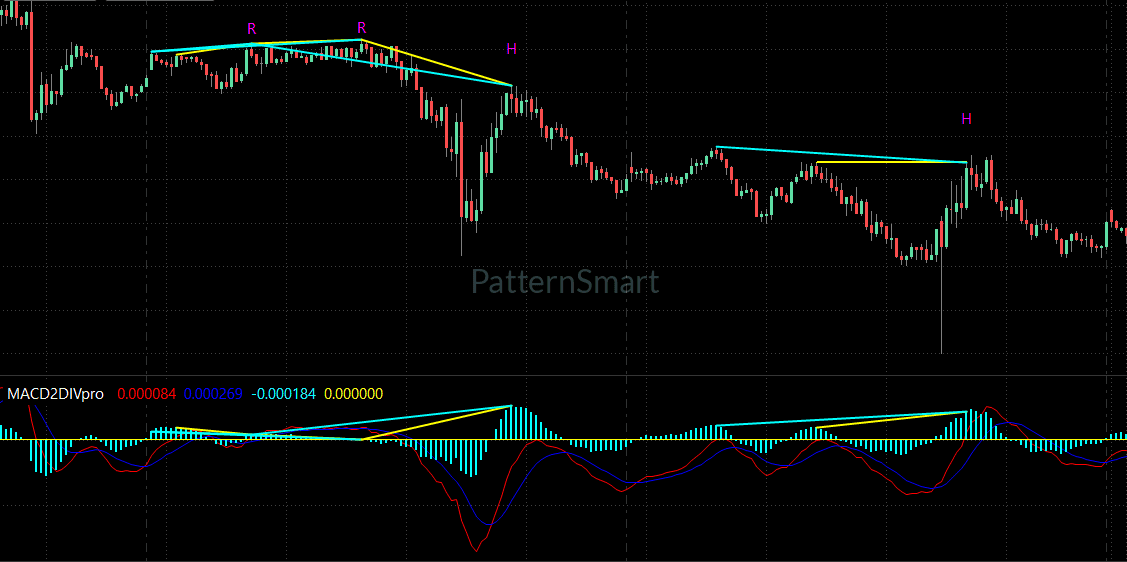
Additional Signal Confirmation with Enhanced Mode
For traders who want an additional layer of structural validation, Enhanced Mode applies further validation before a potential divergence signal is confirmed.
Enhanced Mode does not create a new divergence type or change the Double Divergence methodology.
Instead, it evaluates additional structural relationships between historical divergence anchor points.
This distinction is important:
Wait 1 Bar affects confirmation timing.
Enhanced Mode applies additional structural validation.
The result is a configuration framework that allows traders to determine how much additional validation they want to incorporate into their analytical workflow.
Control Which Divergence Signals Appear
MACD Double Divergence Pro provides independent controls for:
- Show Regular Bullish
- Show Regular Bearish
- Show Hidden Bullish
- Show Hidden Bearish
This allows the chart to focus on the signal categories most relevant to the trader’s current analytical objective.
For example, an analyst studying trend continuation may concentrate on hidden divergence, while an analyst examining potential trend transitions may place greater emphasis on regular divergence.
The settings change which signal categories are calculated and displayed; they do not change the underlying methodology.
Wait 1 Bar for Additional Confirmation
Wait 1 Bar determines whether the indicator requires one completed confirmation bar before finalizing a detected Double Divergence signal.
When enabled, confirmation occurs after the following bar has closed. This can provide additional confirmation and reduce premature signal confirmation during rapidly changing market conditions.
When disabled, signals can be confirmed earlier once the required divergence conditions have been satisfied.
This setting therefore changes when a signal becomes confirmed rather than changing how divergence is identified.
Keep MultiCharts Charts Clear and Informative
Technical analysis becomes harder to evaluate when a chart contains excessive historical annotations.
MACD Double Divergence Pro includes display controls such as:
- Show Char
- Show Line
- Only Show Last Signal Within Bars
- Price Line Brush
- Price Line Dash Style
- Price Line Width
These settings control how confirmed divergence information is presented.
For example, Show Line can display divergence relationships graphically, while Show Char provides signal labels. Only Show Last Signal Within Bars can help manage historical graphical objects and reduce chart clutter.
These are presentation controls. They do not improve or alter signal quality.
Alerts for a More Structured Workflow
MACD Double Divergence Pro also includes:
- Enable Alert
- Alert Sound
Alert features operate after a qualifying Double Divergence signal has been confirmed. They are designed to communicate confirmed signals without changing the indicator’s calculations or confirmation process.
This can be useful within a structured MultiCharts workflow where traders monitor multiple charts or markets and want to reduce the need for continuous manual observation.
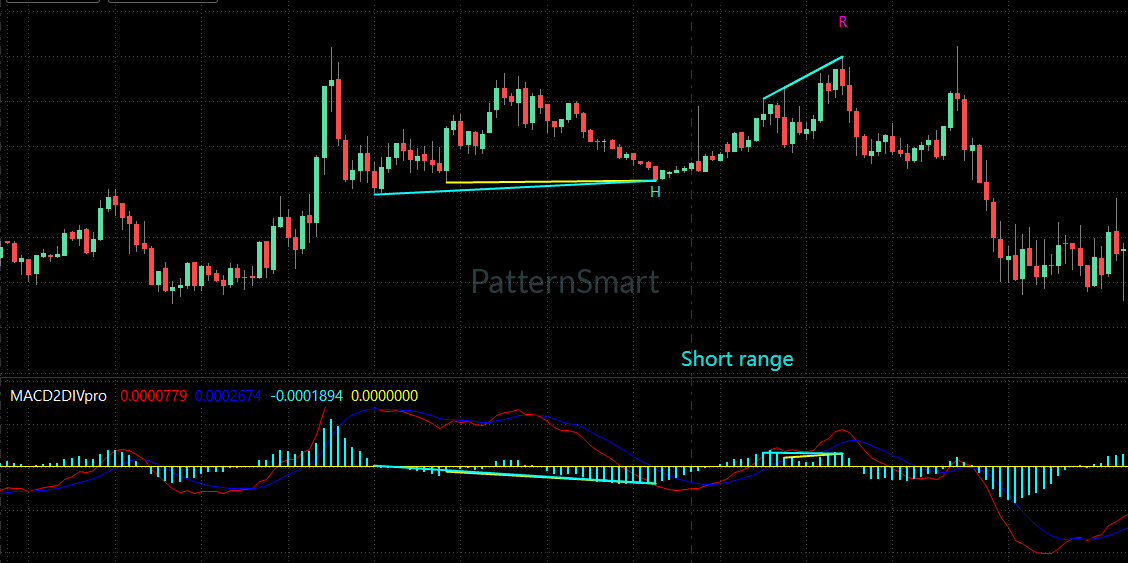
MACD Double Divergence Pro in MultiCharts
MultiCharts is designed around systematic analysis, strategy development, backtesting, optimization, and portfolio-level evaluation.
That environment provides a natural setting for MACD Double Divergence analysis.
Instead of viewing divergence as an isolated chart signal, traders can incorporate the information into a broader, repeatable analytical process.
For example:
- Identify the prevailing market trend.
- Evaluate MACD momentum development.
- Observe whether price and MACD begin to diverge.
- Examine the resulting Double Divergence structure.
- Confirm the observation with market structure and price action.
- Evaluate the condition within the broader trading methodology.
This approach is particularly relevant for systematic traders and strategy developers who value structured and repeatable analysis.
The platform provides the workflow environment; the Double Divergence methodology remains consistent.
Built for Structured MACD Analysis
MACD Double Divergence Pro can support several analytical objectives:
Trend Transition Analysis
Monitor situations where MACD momentum begins changing while price continues to develop in the existing direction.
Momentum Confirmation
Use MACD divergence as additional evidence when evaluating whether a developing trend continues to receive momentum support.
Trend Development
Study how momentum evolves throughout established and developing trends.
Market Structure Evaluation
Combine divergence observations with important price structures, support, resistance, and price action.
These applications are most useful when divergence is treated as analytical information rather than a standalone trading decision.
Who Is MACD Double Divergence Pro For?
MACD Double Divergence Pro is particularly suited to:
- Trend traders
- Swing traders
- Position traders
- Technical analysts
- Systematic traders
- Strategy developers
- Traders studying trend transitions
- Professionals using MultiCharts for structured market evaluation
It can be applied across different markets and timeframes, with the appropriate configuration depending on the trader’s analytical objective.
Frequently Asked Questions
What is MACD Double Divergence?
MACD Double Divergence compares price behavior with MACD-based momentum information to identify situations where the two begin to behave differently.
The objective is to provide additional evidence for evaluating trend transitions and developing market conditions.
Does MACD Double Divergence predict reversals?
No. A divergence should not be interpreted as a guaranteed reversal.
It indicates a difference between price and MACD behavior. Confirmation from price action, market structure, and other technical evidence remains important.
What is the difference between Regular and Hidden Double Divergence?
Regular Double Divergence is generally associated with evaluating potential changes in the existing trend, while Hidden Double Divergence can provide information for evaluating trend continuation following a pullback.
Both should be interpreted within their broader market context.
What MACD values can be used for divergence analysis?
MACD Double Divergence Pro provides three Divergence Value Mode choices: MACD, Avg, and Diff.
This allows traders to examine divergence using different MACD-derived perspectives.
Does Enhanced Mode create different divergence signals?
No. Enhanced Mode provides an additional structural validation layer for signals that have already satisfied the standard Double Divergence conditions.
Can I reduce the number of signals displayed?
Yes. The independent controls for Regular Bullish, Regular Bearish, Hidden Bullish, and Hidden Bearish allow specific signal categories to be enabled or disabled.
Does changing display settings affect signal calculations?
No. Display settings such as Show Char, Show Line, and Only Show Last Signal Within Bars affect presentation rather than the underlying signal calculation.
Bring Structured MACD Divergence Analysis to MultiCharts
Understanding a trend requires more than observing whether price is rising or falling. The development of momentum can provide another perspective on whether the existing market structure is strengthening, weakening, or transitioning.
MACD Double Divergence Pro for MultiCharts combines MACD-based trend momentum analysis with the PatternSmart Double Divergence methodology, giving traders a structured framework for examining divergence, confirmation, and market context.
For MultiCharts users focused on systematic analysis, strategy development, and disciplined technical evaluation, it provides another layer of analytical evidence that can be incorporated into an existing market-analysis workflow.
[Get Started With MACD Double Divergence Pro for MultiCharts]
Looking for the complete mathematical breakdown, step-by-step optimization guides, and advanced trading strategies? Explore our comprehensive documentation:
Visit the Technical Inputs Manual: Double Divergence Pro for full parameter tuning.
Read the master guide on the Double Divergence Indicator Series.