Short-term momentum can change before price movement becomes obvious on the chart. This is one reason Stochastics has remained a widely used oscillator for traders studying market turning points, temporary extremes, and short-term momentum behavior.
Stochastics Double Divergence Pro for MT4 combines Stochastics with the PatternSmart Double Divergence methodology to provide a structured way to examine disagreements between price movement and short-term oscillator behavior.
Instead of treating a single divergence observation as a trading prediction, the methodology examines repeated price and indicator relationships and encourages confirmation through broader market context.
For traders using MetaTrader 4, this creates a practical framework for studying potential reversals, pullbacks, and changes in short-term momentum without changing the familiar MT4 chart-analysis workflow.
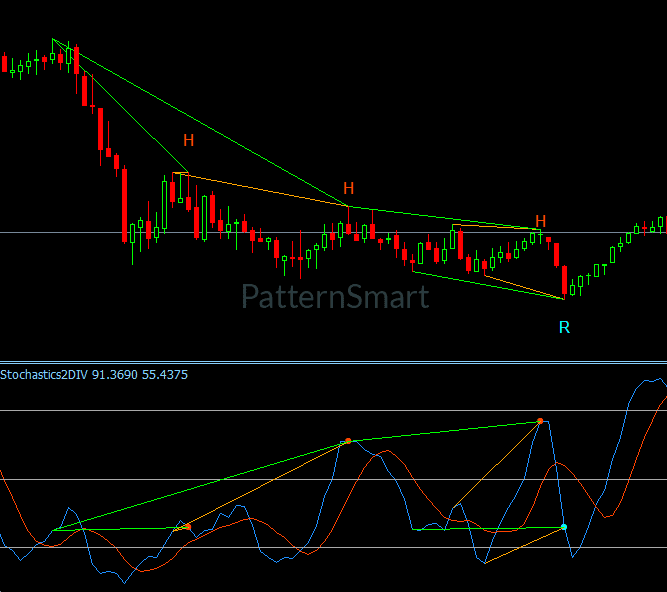
What Is Stochastics Double Divergence?
Stochastics compares the closing price with its recent trading range. This makes it particularly useful for examining short-term momentum and relative market positioning.
When price continues moving in one direction while Stochastics behaves differently, a divergence may develop.
The important question is not simply:
“Is there divergence?”
The more useful question is:
What does the divergence reveal about short-term momentum, and does the surrounding market evidence support that interpretation?
This distinction is central to the PatternSmart methodology.
Divergence is treated as analytical information rather than a guaranteed prediction. Price remains the primary source of information, while Stochastics provides another perspective on market behavior.
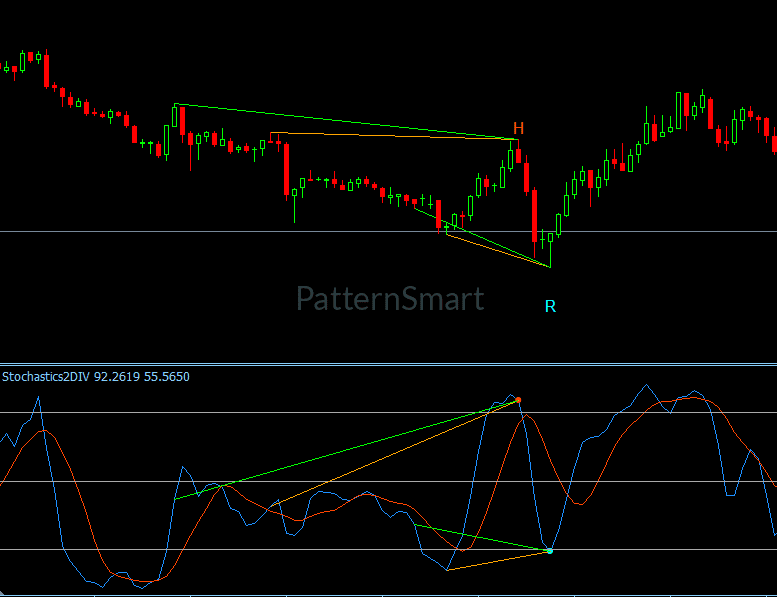
Why Short-Term Momentum Matters
Markets do not always reverse immediately when momentum begins changing.
A market may continue making new highs even while short-term momentum becomes less supportive. Likewise, price may continue declining while downside momentum begins to weaken.
Stochastics is particularly responsive to these short-term changes.
This makes it useful for examining:
- Short-term momentum shifts
- Potential reversal environments
- Temporary market extremes
- Swing trading conditions
- Pullbacks within developing trends
- Changes in oscillator behavior
The responsiveness of Stochastics is also an important consideration. Because it reacts relatively quickly to price movement, it can produce frequent observations, particularly in active or volatile markets.
For that reason, confirmation and market context remain essential.
Stochastics and Reversal Timing
One of the most useful applications of Stochastics Double Divergence is studying potential changes in short-term momentum before a visible price reversal has fully developed.
Consider a market that continues to push toward a new high.
Price appears strong, but the corresponding Stochastics movement does not confirm the new price extreme.
That disagreement does not mean that price must reverse.
Instead, it raises an analytical question:
Is the current price movement still supported by comparable short-term momentum?
The answer requires additional evidence.
Relevant confirmation can include:
- Price action
- Market structure
- Support and resistance
- Broader trend conditions
- Higher-timeframe analysis
- Additional momentum evidence
This confirmation-first approach prevents divergence from being interpreted as an isolated trading instruction.
Understanding the Four Double Divergence Signals
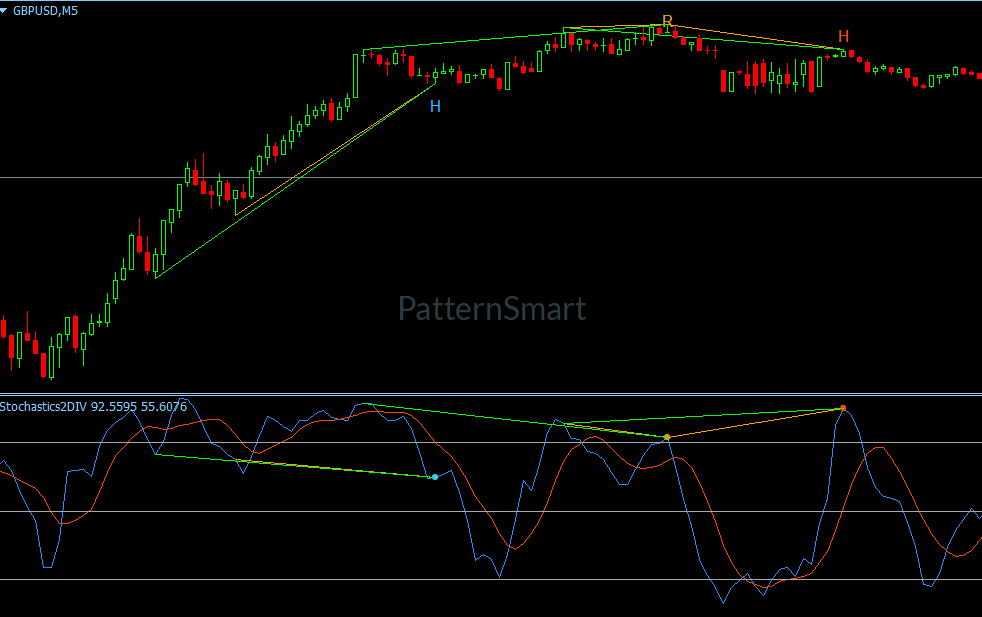
Stochastics Double Divergence Pro identifies four official Double Divergence categories.
Bullish Regular Divergence
Bullish Regular Divergence occurs when:
- Price forms a lower low
- Stochastics forms a higher low
The price movement suggests continued bearish pressure, while Stochastics no longer confirms the full strength of that decline.
This can provide potential evidence of changing bearish conditions.
It does not guarantee that a bullish reversal will occur.
Bearish Regular Divergence
Bearish Regular Divergence occurs when:
- Price forms a higher high
- Stochastics forms a lower high
Price continues to advance while short-term oscillator momentum fails to confirm the new price extreme.
This can provide evidence that the current bullish movement deserves closer examination.
Additional confirmation remains important before forming a broader market interpretation.
Bullish Hidden Divergence
Bullish Hidden Divergence occurs when:
- Price forms a higher low
- Stochastics forms a lower low
This structure commonly appears during a pullback within an existing bullish market structure.
Rather than focusing primarily on reversal, Hidden Divergence provides information about potential trend continuation after temporary weakness.
The broader trend and price structure remain important when interpreting the observation.
Bearish Hidden Divergence
Bearish Hidden Divergence occurs when:
- Price forms a lower high
- Stochastics forms a higher high
The market experiences a temporary upward correction, but the broader bearish structure remains intact.
This may provide analytical evidence that bearish conditions continue despite the temporary price recovery.
Why Double Divergence Uses Two Price Relationships
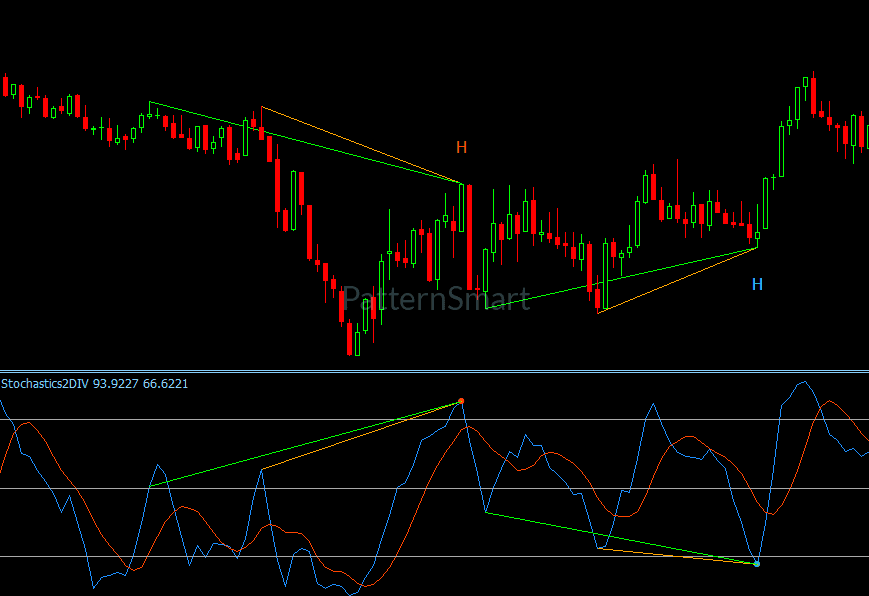
Traditional divergence analysis can focus on one disagreement between price and an indicator.
The PatternSmart Double Divergence methodology places greater emphasis on structured relationships between price swings and indicator behavior.
This helps organize divergence into clearly defined categories rather than treating every oscillator disagreement as equivalent.
The methodology does not rank one signal type as inherently better than another. Instead, each signal should be interpreted according to:
- The divergence classification
- What Stochastics is measuring
- Current market structure
- Broader market conditions
- Additional confirmation
This distinction is particularly important with a responsive oscillator such as Stochastics.
Stochastics Double Divergence for Range and Swing Markets
Stochastics is naturally suited to environments where short-term momentum and market extremes are important.
The indicator knowledge base identifies several conditions where Stochastics Double Divergence can provide useful analytical context:
- Range-bound markets
- Short-term trends
- Swing trading environments
- Reversal situations
- Active discretionary analysis
In a range-bound market, price may repeatedly move between temporary highs and lows. Stochastics can help examine whether short-term momentum is supporting those movements.
During a pullback, Hidden Divergence can provide a different perspective by examining whether the underlying market structure remains consistent with the broader direction.
The key is not to assume that one market condition automatically makes a signal meaningful. Context determines interpretation.
A Confirmation-First Approach
A divergence signal is an observation—not a complete trading decision.
The PatternSmart methodology recommends a progression such as:
Observation → Verification → Confirmation → Interpretation → Decision
For Stochastics Double Divergence, this means a trader can begin with the relationship between price and oscillator movement, then examine whether other technical evidence supports the same interpretation.
For example, a Bullish Regular Divergence observation may become more analytically interesting when it occurs near an important support area and is accompanied by confirming price action.
Likewise, a Bearish Regular Divergence observation near significant resistance may deserve closer attention when broader market structure provides supporting evidence.
The objective is not to accumulate as many indicators as possible. Effective confirmation should be relevant and complementary.
Stochastics Double Divergence Pro for MT4
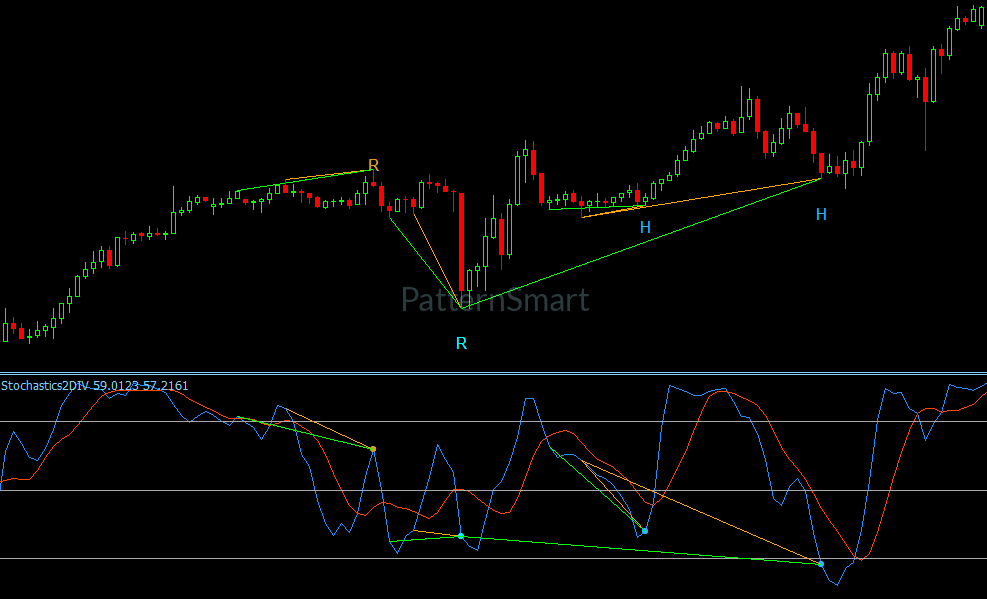
MetaTrader 4 provides an established and familiar environment for practical technical analysis, particularly among Forex and CFD traders.
Stochastics Double Divergence Pro fits naturally into this workflow by adding structured divergence analysis to the existing MT4 chart environment.
The platform remains the workspace; the Double Divergence methodology remains the analytical framework.
This separation is important because the same Double Divergence classification and interpretation principles remain consistent across supported platforms.
Flexible Signal Selection
Stochastics Double Divergence Pro provides independent controls for the four primary signal categories:
- Show Regular Bullish
- Show Regular Bearish
- Show Hidden Bullish
- Show Hidden Bearish
This allows traders to focus their chart analysis on specific divergence categories when appropriate.
For example, a trader studying potential reversal conditions may concentrate on Regular Divergence, while a trader examining pullbacks may place greater attention on Hidden Divergence.
Disabling one signal category does not change the underlying Double Divergence methodology or the behavior of the remaining signal categories.
Wait 1 Bar for Additional Confirmation
Wait 1 Bar controls whether the indicator requires one completed confirmation bar before finalizing a detected divergence signal.
When enabled, the indicator waits for the next bar to close before confirming the signal.
When disabled, the signal can be confirmed once the internal divergence conditions have been satisfied.
This setting changes signal timing, not the underlying definition of divergence.
For short-term Stochastics analysis, this distinction is especially relevant because the oscillator is responsive and can react quickly to changing price conditions. A confirmation delay can therefore become part of how a trader organizes signal review.
Enhanced Mode for Additional Structural Validation
Enhanced Mode applies additional structural validation to potential Double Divergence signals.
It belongs to the product’s Signal Filtering category rather than Signal Generation.
This distinction matters.
The setting does not create a new divergence methodology. Instead, it provides an additional layer of validation before a signal is confirmed.
For traders analyzing responsive Stochastics signals, structural validation can help maintain a more disciplined process when the market produces numerous short-term oscillator movements.
Divergence Bar Range, Lookback, and Filter Length
Stochastics Double Divergence Pro also includes advanced parameters that influence how divergence structures are evaluated.
Divergence Bar Range
Divergence Bar Range defines structural search boundaries used during divergence evaluation.
It helps determine the range within which relevant divergence structures are examined.
Divergence Lookback
Divergence Lookback controls swing-point identification during structural evaluation.
Because divergence depends on meaningful price and indicator swing relationships, this parameter forms part of the structural evaluation process.
Filter Length
Filter Length controls internal smoothing and structural filtering.
Together, these parameters influence how the indicator evaluates potential divergence structures.
They should be viewed as components of the analytical engine rather than independent trading strategies.
Clear Divergence Visualization
Stochastics Double Divergence Pro provides chart-display controls designed to make confirmed signals easier to review.
Show Char
Show Char displays text labels for confirmed divergence signals.
Labels can identify categories such as:
- Regular Bullish
- Regular Bearish
- Hidden Bullish
- Hidden Bearish
Show Line
Show Line draws divergence lines between the relevant price and indicator swing points.
This can make the underlying divergence structure easier to visually inspect.
Only Show Last Signal Within Bars
Only Show Last Signal Within Bars helps reduce chart clutter by removing older nearby graphical objects according to the configured setting.
These visualization settings affect presentation rather than divergence calculations.
Alerts for Confirmed Signals
For traders who monitor multiple MT4 charts, Enable Alert and Alert Sound provide notification functionality for confirmed Double Divergence signals.
Alerts operate after the signal has already been confirmed.
They do not alter:
- Divergence calculation
- Structural evaluation
- Signal filtering
- Signal classification
This makes alerts a workflow feature rather than an analytical filter.
Practical Applications of Stochastics Double Divergence
Stochastics Double Divergence can support several forms of technical analysis.
Short-Term Reversal Analysis
Regular Divergence can help identify situations where price reaches a new extreme while short-term momentum fails to provide equivalent confirmation.
This can help traders investigate potential changes in market conditions.
Pullback Analysis
Hidden Divergence provides another perspective during market corrections.
Rather than assuming every pullback represents a reversal, traders can examine whether the price structure and Stochastics behavior remain consistent with the broader trend.
Range Analysis
In range-bound markets, short-term market extremes occur frequently.
Stochastics Double Divergence can provide additional information about whether momentum is supporting a movement toward a range boundary.
Active Chart Review
Because Stochastics is responsive, the indicator can be useful for traders who actively monitor short-term momentum and reversal conditions.
However, responsiveness also means that confirmation remains important. More frequent observations do not automatically mean better analysis.
Stochastics Double Divergence vs. Traditional Stochastics
Traditional Stochastics analysis can help traders understand short-term momentum and relative price positioning.
Stochastics Double Divergence adds a structured framework for comparing that oscillator behavior with price structure.
The distinction can be summarized as follows:
| Traditional Stochastics Analysis | Stochastics Double Divergence |
|---|---|
| Focuses on oscillator behavior | Compares oscillator behavior with price structure |
| Examines short-term momentum | Examines short-term momentum through divergence |
| Can highlight market extremes | Classifies Regular and Hidden Divergence |
| Often used for timing analysis | Adds structured confirmation to timing analysis |
| Requires contextual interpretation | Explicitly emphasizes confirmation and market context |
The goal is not to replace conventional Stochastics analysis. Instead, Double Divergence provides another analytical layer.
Who Is Stochastics Double Divergence Pro for MT4?
The indicator may be particularly relevant to:
- Swing traders studying short-term momentum
- Day traders analyzing potential market reversals
- Active technical analysts
- Traders who use Stochastics as part of their existing analysis
- MT4 users looking for structured divergence analysis
- Traders studying both reversal and continuation conditions
It can be applied across different markets and timeframes where Stochastics and divergence analysis are appropriate. The most important consideration is matching the analysis to the market environment rather than assuming one configuration is universally suitable.
[Get Started With Stochastics Double Divergence Pro for MT4]
Looking for the complete mathematical breakdown, step-by-step optimization guides, and advanced trading strategies? Explore our comprehensive documentation:
Visit the Technical Inputs Manual: Double Divergence Pro for full parameter tuning.
Read the master guide on the Double Divergence Indicator Series.
Frequently Asked Questions
What does Stochastics measure?
Stochastics compares closing prices with recent trading ranges. It is primarily useful for evaluating short-term momentum, relative market positioning, and oscillator behavior.
What is Stochastics Double Divergence?
Stochastics Double Divergence compares price structure with Stochastics behavior to identify structured Regular and Hidden Divergence observations.
Does Stochastics Double Divergence predict reversals?
No. Divergence provides analytical information rather than a guaranteed prediction. Regular Divergence may indicate that existing momentum deserves closer examination, while Hidden Divergence may provide information about potential continuation.
What is the difference between Regular and Hidden Divergence?
Regular Divergence is generally associated with potential changes in existing market conditions. Hidden Divergence is commonly associated with pullbacks and potential continuation of an existing trend.
Does the MT4 version detect bullish and bearish divergence?
Yes. The documented signal-generation controls include Show Regular Bullish, Show Regular Bearish, Show Hidden Bullish, and Show Hidden Bearish.
Why is confirmation important with Stochastics?
Stochastics is relatively responsive and can produce frequent short-term observations. Confirmation helps place those observations within broader price structure and market context.
Can Stochastics Double Divergence be used by itself?
It is designed as an analytical component rather than a complete decision-making system. Price action, market structure, support and resistance, and other relevant evidence can provide additional context.
Can I reduce the number of signals displayed?
The product provides independent controls for the four divergence categories, along with Enhanced Mode and structural parameters such as Divergence Bar Range, Divergence Lookback, and Filter Length. Visualization controls such as Only Show Last Signal Within Bars can also reduce chart clutter.
Conclusion
Stochastics is particularly valuable when the analytical objective is to understand short-term momentum, reversal timing, relative market positioning, and oscillator behavior.
Stochastics Double Divergence extends that perspective by placing oscillator behavior into a structured price-versus-indicator framework.
The four Double Divergence categories provide different forms of information:
- Bullish Regular Divergence — potential evidence of changing bearish conditions
- Bearish Regular Divergence — potential evidence that bullish conditions deserve closer examination
- Bullish Hidden Divergence — potential evidence supporting bullish continuation after a pullback
- Bearish Hidden Divergence — potential evidence supporting bearish continuation after a correction
For MT4 traders, the product combines this methodology with configurable signal generation, structural validation, visualization, and confirmed-signal alerts.
The central principle remains simple: divergence is information, not certainty. The most meaningful analysis comes from combining the Stochastics observation with price structure, market context, and appropriate confirmation.
Explore Stochastics Double Divergence Pro for MT4
If your technical analysis focuses on short-term momentum and reversal timing, Stochastics Double Divergence Pro for MT4 provides a structured way to examine how oscillator behavior relates to price movement.
Explore the indicator, review its documented features, and evaluate how Double Divergence analysis can fit into your existing MT4 technical analysis workflow.