The Deliberation pattern (also known as the Stalled pattern) is a three-candle bearish reversal structure that appears at the peak of an established uptrend. It represents a progressive weakening of bullish momentum, alerting technical traders that the buyers are beginning to hesitate, or “deliberate,” before potentially relinquishing control to the bears.
While it is classified as a reversal signal, the pattern itself doesn’t guarantee an immediate crash. Instead, it serves as an early structural warning sign that the prevailing trend is losing steam.
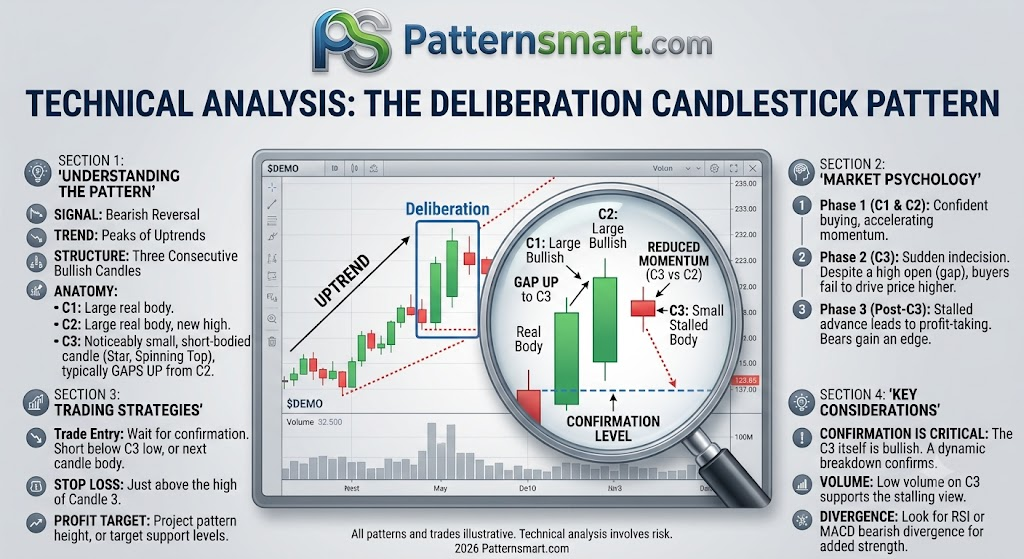
Anatomy of the Pattern
To classify three candles as a Deliberation pattern, the structure must satisfy the following criteria within an uptrend:
- Candle 1 (Bullish): A strong, long green (or white) candlestick that firmly extends the existing bullish trend.
- Candle 2 (Bullish): Another long green candlestick. Its open should be within the body of Candle 1, and its close must mark a new high. The body should be comparable in size to Candle 1.
- Candle 3 (Bullish/Star): A noticeably small green candlestick (often a spinning top or short-bodied candle) that gaps up above the close of Candle 2, or opens very near its peak. The critical detail is that its real body is drastically smaller than the previous two candles, showcasing a sudden, severe deceleration in buying momentum.
Market Psychology Behind the Movement
The sequence of candles paints a vivid picture of shifts in market psychology:
- Unchecked Optimism: On the first two days, bulls are in complete control. They aggressively bid the asset up, printing back-to-back large, healthy bullish bodies.
- The Sudden Hesitation: On the third day, the market opens with strength (often a small gap up), which initially looks like a continuation of the rally. However, institutional buying evaporates.
- The Stalled Advance: Despite the high open, buyers lack the conviction to drive prices significantly higher, resulting in a tiny closing body.
The bulls are literally “deliberating” whether the current high valuations are justified. Because the market stalled after a strong rally, short-sellers begin circling, and long-holders consider taking profits.
Trading Strategies and Execution
Because the third candle is still technically bullish (closing higher than it opened), trading the Deliberation pattern requires waiting for explicit confirmation. Entering a short position too early risks getting caught in a temporary consolidation before the uptrend continues.
| Element | Tactical Level | Execution Rules |
| Trade Entry | Short Confirmation | Wait for the candle following the pattern to break down. Enter a short position when price falls below the low of Candle 3’s body (or Candle 2’s upper range). |
| Stop Loss | Risk Management | Place the stop loss order slightly above the highest wick of Candle 3 to protect against a continuation of the uptrend. |
| Profit Target | Take Profit | Target nearby support structural zones, prior swing lows, or dynamic support lines like the 20-period Exponential Moving Average (EMA). |
Distinguishing Deliberation from Three White Soldiers
It is easy to mistake the Deliberation pattern for the highly bullish Three White Soldiers pattern, as both consist of three consecutive green candles making new highs. However, their implications are completely opposite.
- Three White Soldiers: All three candles feature large, robust real bodies with little to no upper wicks. It signifies accelerating strength and a powerful trend continuation.
- Deliberation Pattern: The first two candles match the Soldiers pattern, but the third candle stalls completely, shrinking to a fraction of the size of the previous candles. It signifies trend exhaustion.
Pro Tip: Look for momentum divergence. If the Deliberation pattern prints while the Relative Strength Index (RSI) or MACD displays a clear bearish divergence (making lower highs while price makes higher highs), the reliability of the reversal signal increases drastically.
Please check our Bearish and Bullish Patterns Indicator collection.