Structured Trend Strength and Trend Quality Analysis for MetaTrader 5
A price trend can continue moving in the same direction even when the underlying strength of that trend begins to change. This creates an important analytical question for trend traders:
Is the current trend still supported by the same level of underlying strength?
ADX is specifically designed to examine trend strength rather than trend direction. When combined with PatternSmart’s Double Divergence methodology, it provides a structured way to study situations where price continues advancing or declining while ADX behavior begins to diverge from the price structure.
ADX Double Divergence Pro for MT5 brings this analysis to MetaTrader 5, providing traders with a confirmation-oriented framework for evaluating trend strength, trend quality, continuation, and potential changes in directional conviction.
Rather than treating divergence as an automatic reversal signal, the methodology uses it as additional technical evidence within a broader market-analysis process.
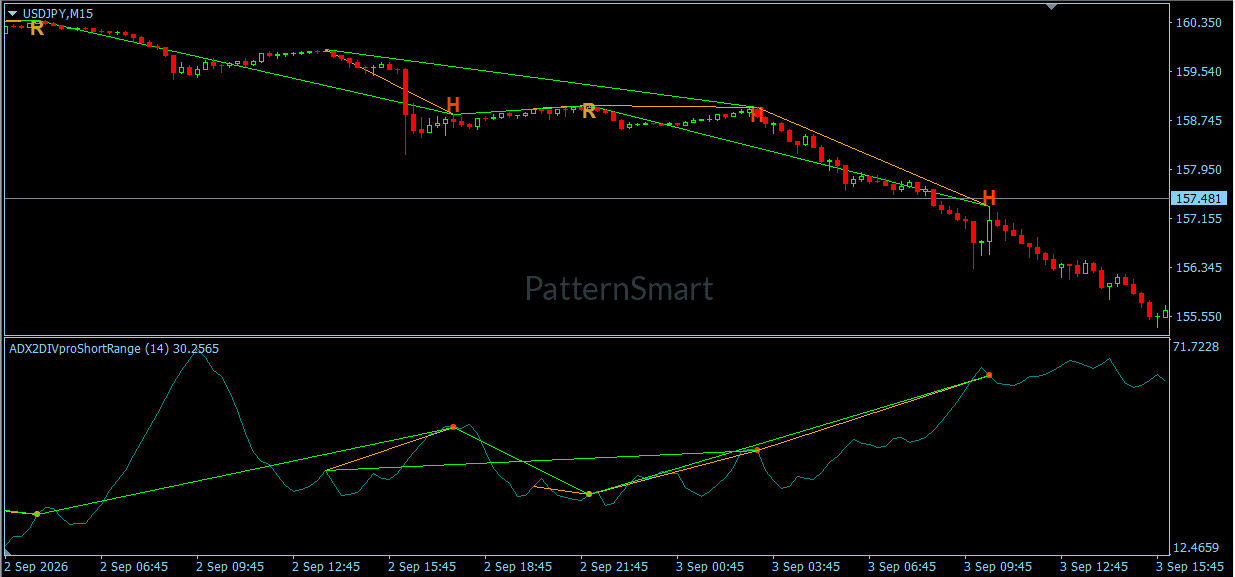
What Is ADX Double Divergence?
The Average Directional Index (ADX) measures the strength of a trend. Importantly, ADX does not determine whether the market is bullish or bearish by itself. Instead, it helps answer a different question:
How strong is the current trend?
This makes ADX fundamentally different from indicators that focus primarily on momentum, market extremes, or buying and selling pressure.
When ADX is incorporated into Double Divergence analysis, the focus becomes the relationship between price movement and trend strength.
For example, price may continue establishing new highs while ADX fails to confirm the increasing strength of the trend. This does not automatically mean that price will reverse. Instead, it can indicate that the quality or underlying strength of the trend is changing.
That distinction is central to using ADX Double Divergence correctly.
The PatternSmart Indicator Knowledge Base identifies the primary analytical focus of ADX Double Divergence as:
- Trend strength
- Trend quality
- Directional conviction
- Trend continuation
It is therefore designed around trend evaluation, rather than overbought or oversold analysis.
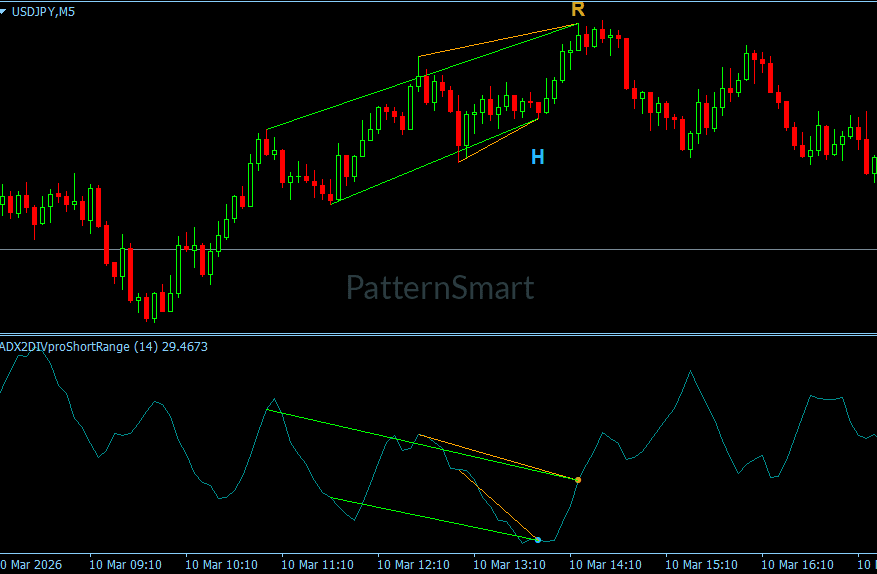
Why ADX Is Different From Momentum Oscillators
Many technical indicators are designed to identify changes in momentum or market extremes. ADX serves a different analytical purpose.
ADX focuses on trend strength.
This means an ADX Double Divergence observation should not automatically be interpreted as a reversal warning.
Consider a strong upward market:
- Price continues to make higher highs.
- The trend remains structurally bullish.
- ADX begins failing to confirm the continued expansion in price.
- The divergence suggests that trend strength may be changing.
- The trader evaluates whether additional evidence supports that interpretation.
The market may eventually reverse, consolidate, or simply continue upward with less trend strength.
ADX Double Divergence helps evaluate that changing trend quality rather than attempting to predict which outcome must occur.
This is one of the most important distinctions between ADX Double Divergence and oscillator-based divergence tools.
ADX Double Divergence and Trend Quality
Trend direction and trend strength are not the same thing.
A market can remain in an uptrend even while the strength of that trend decreases. Likewise, a downtrend can remain intact while its underlying directional conviction weakens.
This is where ADX divergence can become particularly informative.
Trend Direction
Price structure answers questions such as:
- Are highs and lows moving upward?
- Are highs and lows moving downward?
- Is price breaking important structural levels?
- Is the market consolidating?
Trend Strength
ADX provides another perspective:
- Is the trend maintaining strength?
- Is trend strength increasing?
- Is trend strength weakening?
- Is price movement being accompanied by comparable trend strength?
Trend Quality
Double Divergence brings these observations together.
When price and ADX begin communicating different information, traders have another reason to examine whether the existing trend remains as strong as its price movement suggests.
The objective is not prediction. It is better interpretation of current market conditions.
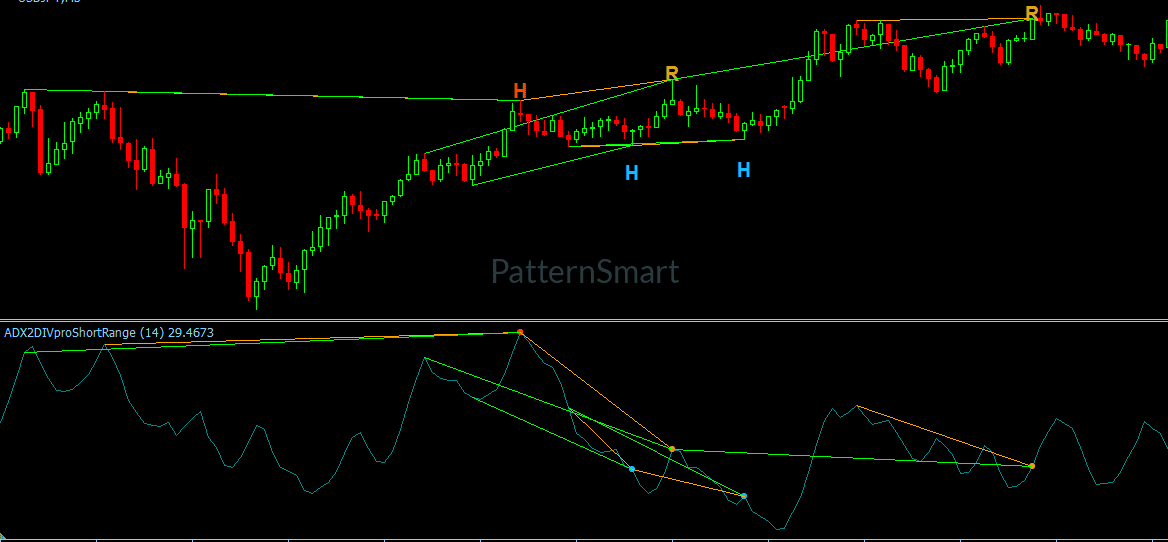
The Double Divergence Methodology
Traditional divergence compares price behavior with an indicator.
PatternSmart’s Double Divergence methodology builds on this concept through a structured, confirmation-first approach.
The methodology emphasizes:
- Price action
- Indicator behavior
- Market structure
- Context
- Confirmation
- Disciplined interpretation
The analytical process can be summarized as:
Observe → Compare → Confirm → Interpret → Evaluate
The indicator supplies one form of technical evidence. The trader then evaluates that evidence alongside the broader market environment.
This is important because divergence does not guarantee a reversal. It simply indicates that price and the selected indicator are no longer behaving in complete agreement.
Confirmation therefore strengthens analytical confidence rather than creating certainty.
Four Types of ADX Double Divergence
ADX Double Divergence Pro supports four official divergence classifications.
Bullish Regular Divergence
Bullish Regular Divergence occurs when price establishes a lower low while the indicator establishes a higher low.
With ADX, this observation should be interpreted specifically through the lens of trend strength.
It may provide information about changing downside trend strength, but it should not automatically be interpreted as proof that a bullish reversal will occur.
Price structure and additional confirmation remain important.
Bearish Regular Divergence
Bearish Regular Divergence occurs when price establishes a higher high while the indicator forms a lower high.
For ADX, this can indicate that upward trend strength is failing to confirm the new price extreme.
This may be useful when evaluating whether an established uptrend is losing strength.
However, weakening trend strength does not necessarily mean that the market will immediately reverse.
Bullish Hidden Divergence
Bullish Hidden Divergence occurs when price forms a higher low while the indicator forms a lower low.
Within an established bullish market structure, this can provide information relevant to trend continuation analysis.
The ADX-specific interpretation centers on whether the trend remains sufficiently supported to maintain its broader structure.
Bearish Hidden Divergence
Bearish Hidden Divergence occurs when price forms a lower high while the indicator forms a higher high.
Within an established downtrend, this observation can contribute to continuation analysis by examining the relationship between price structure and trend-strength behavior.
Regular and Hidden Divergence represent different forms of analytical information. Neither category should be treated as inherently superior; context and confirmation determine their significance.
ADX Double Divergence for Trend Continuation Analysis
One of the strongest educational applications of ADX Double Divergence is understanding trend continuation.
A trend does not need to reverse simply because its strength changes.
For example, an established bullish market may experience a pullback while maintaining a sequence of higher lows. A Hidden Bullish Divergence observation can then provide additional information for evaluating whether the broader trend structure remains intact.
This creates a useful distinction:
Trend strength analysis asks:
Is the trend becoming stronger or weaker?
Trend structure analysis asks:
Is the trend still structurally intact?
Double Divergence analysis asks:
Does ADX behavior confirm or contradict what price structure is communicating?
Considering these questions together can produce a more complete interpretation than looking at ADX alone.
The Indicator Knowledge Base specifically identifies Hidden Divergence as particularly useful for continuation analysis during established trends.
ADX Divergence Does Not Mean Immediate Reversal
This point deserves emphasis.
If price continues making higher highs while ADX makes lower highs, the correct interpretation is not necessarily:
“The market must reverse.”
A more appropriate analytical interpretation is:
Trend strength is no longer confirming price movement to the same degree.
Several outcomes remain possible:
- The trend may continue.
- The market may consolidate.
- Price may experience a deeper pullback.
- Trend strength may recover.
- A larger structural transition may eventually develop.
The divergence provides information about the relationship between price and trend strength. It does not determine the market’s next outcome.
This confirmation-based philosophy is fundamental to PatternSmart Double Divergence.
Where ADX Double Divergence Is Most Relevant
The ADX Indicator Knowledge Base identifies several market environments where ADX Double Divergence can provide useful analytical context:
- Strong trending markets
- Breakout environments
- Sustained directional movement
- Medium- to long-duration trends
These environments are particularly relevant because ADX is designed to evaluate trend strength.
By contrast, ADX Double Divergence is less effective as a standalone analytical perspective during sideways markets, where there may be limited sustained trend strength to evaluate.
ADX Double Divergence Pro Features for MT5
ADX Double Divergence Pro provides a configurable set of inputs organized into five official categories:
- Signal Generation
- Signal Filtering
- Alerts & Notifications
- Display & Visualization
- Advanced Parameters
This structure allows traders to adapt the indicator to different analytical workflows without changing the underlying Double Divergence methodology.
Signal Generation
Wait 1 Bar
Wait 1 Bar determines whether the indicator requires one completed confirmation bar before finalizing a detected divergence signal.
The default value is True.
When enabled, the indicator waits until the next bar has completely closed before confirming the signal. This can provide additional confirmation and reduce premature signal confirmation.
When disabled, the signal can be confirmed immediately once the internal divergence conditions have been satisfied.
Importantly, this setting changes when the signal becomes visible, not how the divergence itself is detected.
Show Regular Bullish
Show Regular Bullish controls whether regular bullish Double Divergence signals are calculated and displayed.
The default value is True.
Show Regular Bearish
Show Regular Bearish controls whether regular bearish Double Divergence signals are calculated and displayed.
The default value is True.
Show Hidden Bullish
Show Hidden Bullish controls whether hidden bullish Double Divergence signals are calculated and displayed.
The default value is True.
Show Hidden Bearish
Show Hidden Bearish controls whether hidden bearish Double Divergence signals are calculated and displayed.
The default value is True.
These four controls allow traders to determine which divergence classifications are relevant to their analytical workflow.
Signal Filtering and Advanced Parameters
Enhanced Mode
Enhanced Mode is a Signal Filtering feature that applies additional structural filtering.
Its default value is False.
It should be understood as a quality-control mechanism rather than an independent trading system.
Divergence Bar Range
Divergence Bar Range controls divergence swing distance.
Its default value is ShortRange.
This setting belongs to the indicator’s advanced configuration and contributes to how divergence structures are evaluated.
Divergence Lookback
Divergence Lookback controls swing point detection.
The default value is 5.
It belongs to the Advanced Parameters category.
Filter Length
Filter Length controls smoothing and structural filtering.
The default value is 5.
Together, these advanced parameters allow the indicator to be adapted to different analytical requirements while keeping the underlying methodology consistent.
Alerts and Chart Visualization
ADX Double Divergence Pro also includes tools designed to make confirmed divergence observations easier to monitor and interpret.
Enable Alert
Enable Alert enables real-time alerts.
The default value is True.
Alert Sound
Alert Sound determines the notification sound.
The default value is Alert1.wav.
Show Char
Show Char displays text labels on the chart.
Show Line
Show Line draws divergence lines.
Only Show Last Signal Within Bars
Only Show Last Signal Within Bars helps reduce chart clutter by removing older nearby signals.
Its default value is 10.
Additional display controls include:
- Price Line Brush
- Price Line Dash Style
- Price Line Width
These settings control how divergence information is presented without changing the analytical methodology itself.
ADX Double Divergence Pro on MetaTrader 5
MetaTrader 5 is classified within the PatternSmart platform framework as a multi-asset trading platform.
Its typical users include traders working across markets such as:
- Forex
- Stocks
- Futures
The platform’s primary strength is identified as flexibility, with a writing emphasis on modern trading.
For ADX Double Divergence Pro, this creates a practical environment for analyzing trend strength across different markets while maintaining the same PatternSmart methodology.
The platform changes the workflow and user experience. It does not change the Double Divergence analytical principles.
Why ADX Double Divergence Fits a Trend-Focused MT5 Workflow
ADX Double Divergence is naturally aligned with traders who want to evaluate the quality and sustainability of directional movement.
The Indicator Knowledge Base identifies suitable trading styles including:
- Trend following
- Position trading
- Swing trading during established trends
- Breakout trading
It also identifies potential users such as:
- Trend traders
- Futures traders
- Forex traders
- Traders seeking additional trend confirmation
For these users, the value of ADX Double Divergence lies less in producing more signals and more in adding another perspective to trend evaluation.
Practical ADX Double Divergence Analysis
A disciplined workflow can help prevent ADX divergence from being interpreted in isolation.
Step 1: Start With Price Structure
First examine the market itself.
Identify:
- Higher highs and higher lows
- Lower highs and lower lows
- Breakouts
- Pullbacks
- Consolidation
- Important support and resistance
Price action remains the primary source of information.
Step 2: Evaluate Trend Strength
Use ADX to examine the strength of the existing trend.
The question is not simply whether price is moving upward or downward.
The question is whether the underlying trend strength is supporting that movement.
Step 3: Identify the Divergence Classification
Determine whether the observation is:
- Bullish Regular Divergence
- Bearish Regular Divergence
- Bullish Hidden Divergence
- Bearish Hidden Divergence
Step 4: Evaluate Trend Quality
Ask whether ADX is confirming the current price structure or communicating a different trend-strength condition.
Step 5: Seek Independent Confirmation
Additional evidence may come from:
- Price action
- Market structure
- Support and resistance
- Breakout behavior
- Other technical indicators
The quality of confirmation is more important than simply accumulating more indicators.
Step 6: Interpret the Complete Picture
Finally, evaluate all available evidence before making an independent trading decision.
This preserves the central PatternSmart process:
Observe → Compare → Confirm → Interpret → Evaluate.
ADX Double Divergence vs. Traditional ADX Analysis
Traditional ADX analysis focuses primarily on the strength of a trend.
ADX Double Divergence adds another analytical layer by comparing trend strength behavior with price structure.
Traditional ADX
- Evaluates trend strength
- Helps assess trend quality
- Does not independently establish trend direction
- Can contribute to trend-following analysis
ADX Double Divergence
- Compares price structure with ADX behavior
- Identifies Regular and Hidden Divergence
- Provides bullish and bearish divergence classifications
- Adds structured confirmation
- Helps evaluate whether trend strength is supporting current price movement
- Supports continuation analysis within established trends
This does not make divergence a replacement for conventional ADX analysis. Instead, it creates another framework for interpreting the relationship between price and trend strength.
Key Analytical Benefits
Evaluate Trend Quality
ADX Double Divergence can help traders examine whether trend strength continues to support the current price structure.
Study Directional Conviction
Price may continue moving in one direction even while underlying trend strength changes. Divergence can highlight this discrepancy for further analysis.
Support Continuation Analysis
Hidden Divergence can provide additional context when evaluating pullbacks within established trends.
Add Confirmation to Breakout Analysis
ADX is particularly relevant to sustained directional movement and breakout environments, making its divergence perspective useful when evaluating whether trend strength is supporting a developing move.
Maintain a Structured Workflow
The combination of official divergence classifications, confirmation settings, filtering options, alerts, and chart visualization supports a more organized analytical process.
These benefits are analytical rather than performance guarantees. PatternSmart’s methodology emphasizes evidence evaluation and probability rather than certainty.
Who Is ADX Double Divergence Pro for MT5?
ADX Double Divergence Pro is particularly relevant to traders who focus on trend strength and market structure rather than primarily seeking overbought or oversold conditions.
It may be relevant for:
- Trend-following traders
- Forex traders
- Futures traders
- Breakout traders
- Position traders
- Swing traders working with established trends
- Traders seeking additional trend confirmation
The product is less suited to an analytical approach centered exclusively on sideways-market conditions because ADX’s primary purpose is evaluating trend strength.
Frequently Asked Questions
What is ADX Double Divergence Pro for MT5?
ADX Double Divergence Pro for MT5 is a PatternSmart technical analysis indicator that combines ADX-based trend-strength analysis with the Double Divergence methodology. It helps traders examine relationships between price structure and trend strength.
What does ADX measure?
ADX measures trend strength, not trend direction. This makes it useful for evaluating the quality and sustainability of directional movement.
Does ADX Double Divergence predict trend reversals?
No. ADX divergence indicates that price and trend-strength behavior are no longer fully aligned. It can provide useful information about changing trend quality, but it does not guarantee an immediate reversal.
What are the four ADX Double Divergence signals?
The indicator supports:
- Bullish Regular Divergence
- Bearish Regular Divergence
- Bullish Hidden Divergence
- Bearish Hidden Divergence
Their interpretation depends on market structure and confirmation.
Is ADX Double Divergence useful for trend continuation?
Yes. Hidden Divergence can be particularly relevant when evaluating continuation within established trends.
Can ADX tell me whether a trend is bullish or bearish?
ADX itself measures trend strength rather than direction. Price structure and directional analysis are therefore important when interpreting ADX information.
Is ADX Double Divergence suitable for Forex trading on MT5?
The PatternSmart Indicator Knowledge Base identifies Forex traders among the typical users of ADX Double Divergence, while MT5 is classified as a multi-asset platform commonly associated with Forex, stocks, and futures.
Can I choose which divergence types are displayed?
Yes. Separate settings are available for Show Regular Bullish, Show Regular Bearish, Show Hidden Bullish, and Show Hidden Bearish.
Does ADX Double Divergence provide alerts?
Yes. The product includes Enable Alert and Alert Sound settings for notification behavior.
What does Wait 1 Bar do?
When enabled, Wait 1 Bar requires one completed confirmation bar before a detected Double Divergence signal is finalized. It changes signal timing rather than the underlying divergence detection process.
Can ADX Double Divergence be used by itself?
It is designed as an analytical tool rather than a standalone automated trading system. Price action, market structure, and additional confirmation should remain part of the broader analysis.
Conclusion
A trend can remain visually intact while its underlying strength begins to change. That distinction is one of the central reasons ADX can be useful in technical analysis.
ADX Double Divergence Pro for MT5 provides a structured way to examine that relationship by comparing price behavior with ADX trend-strength behavior.
Instead of treating divergence as a prediction, the PatternSmart methodology uses it as additional evidence for evaluating:
- Trend strength
- Trend quality
- Directional conviction
- Continuation
- Breakout conditions
- Changes in market structure
The analytical process remains straightforward:
Observe price. Compare ADX behavior. Confirm with broader evidence. Interpret the market context. Evaluate the complete picture.
For traders using MetaTrader 5 who want a dedicated tool for structured trend-strength and divergence analysis, ADX Double Divergence Pro provides a methodology-driven approach that fits naturally into a modern multi-asset technical analysis workflow.
Explore ADX Double Divergence Pro for MT5 and apply structured trend-strength analysis to your own charts.
[Get Started With Double Divergence Pro for MT5]
Looking for the complete mathematical breakdown, step-by-step optimization guides, and advanced trading strategies? Explore our comprehensive documentation:
Visit the Technical Inputs Manual: Double Divergence Pro for full parameter tuning.
Read the master guide on the Double Divergence Indicator Series.