Advanced Short-Term Momentum and Reversal Analysis for MetaTrader 5
Short-term market movements can change quickly. Price may continue moving toward a new extreme while underlying momentum begins to behave differently. Recognizing that change can provide useful information when evaluating potential reversals, temporary extremes, and changing market conditions.
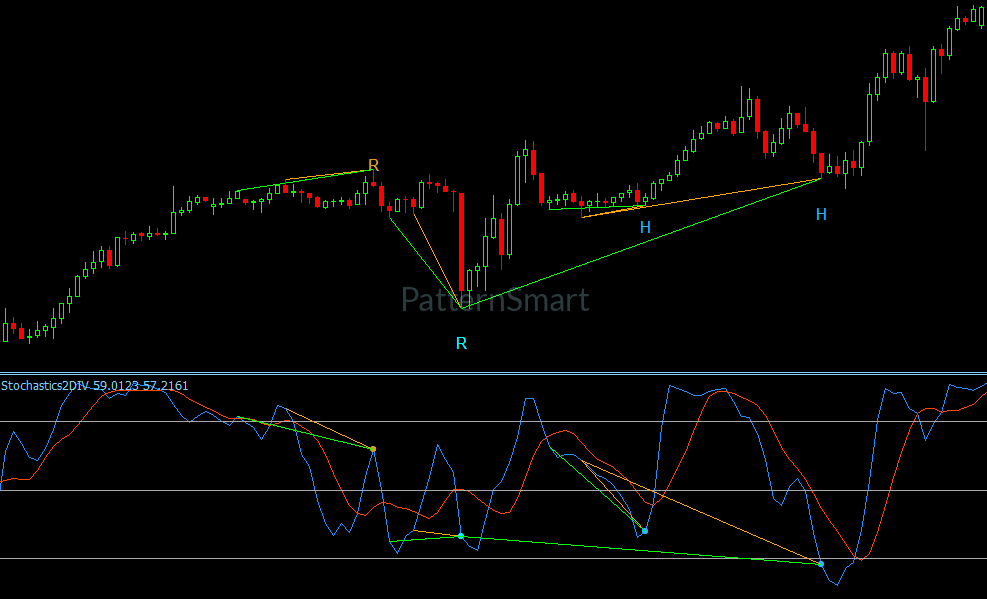
Stochastics Double Divergence Pro for MT5 brings PatternSmart’s Double Divergence methodology to MetaTrader 5, combining Stochastics-based momentum analysis with a structured approach to divergence and confirmation.
Stochastics is particularly useful for evaluating short-term momentum because it compares closing prices with recent trading ranges. When this information is analyzed through the Double Divergence framework, traders can examine situations where price movement and short-term momentum are no longer developing in complete agreement.
The objective is not to predict the next price movement. Instead, the indicator provides additional analytical evidence that can help traders evaluate market conditions within a broader technical analysis process.
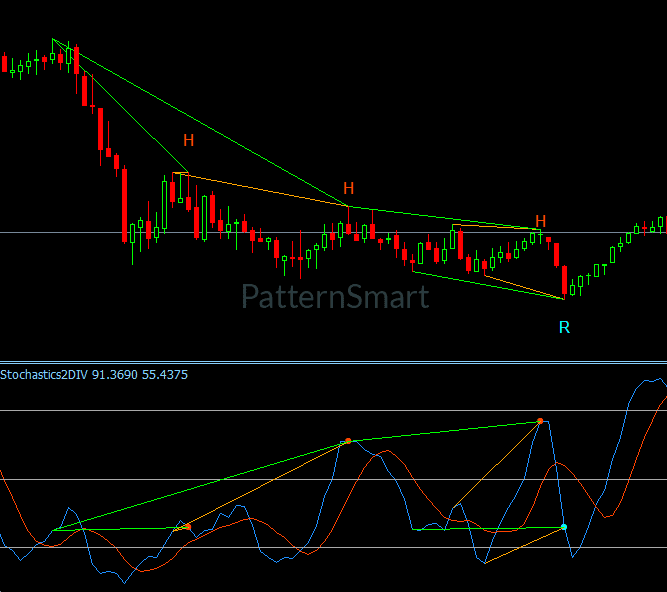
What Is Stochastics Double Divergence?
Stochastics is an oscillator that evaluates the relative position of closing prices within a recent trading range. This makes it useful for studying short-term momentum, oscillator movement, and potential changes around market extremes.
Traditional divergence occurs when price and an indicator stop confirming each other’s movement. For example, bullish divergence can occur when price forms a lower low while the indicator forms a higher low, while bearish divergence can occur when price forms a higher high while the indicator forms a lower high.
PatternSmart’s Double Divergence methodology applies a more structured, confirmation-oriented approach to this concept. Divergence is treated as analytical information rather than a guaranteed prediction. Price action remains the primary source of information, while the indicator provides an additional perspective on market behavior.
The methodology emphasizes:
- Price action
- Indicator behavior
- Market context
- Technical confirmation
- Disciplined interpretation
This approach is particularly relevant when analyzing short-term momentum because oscillator behavior can change before the full effect becomes obvious in price.
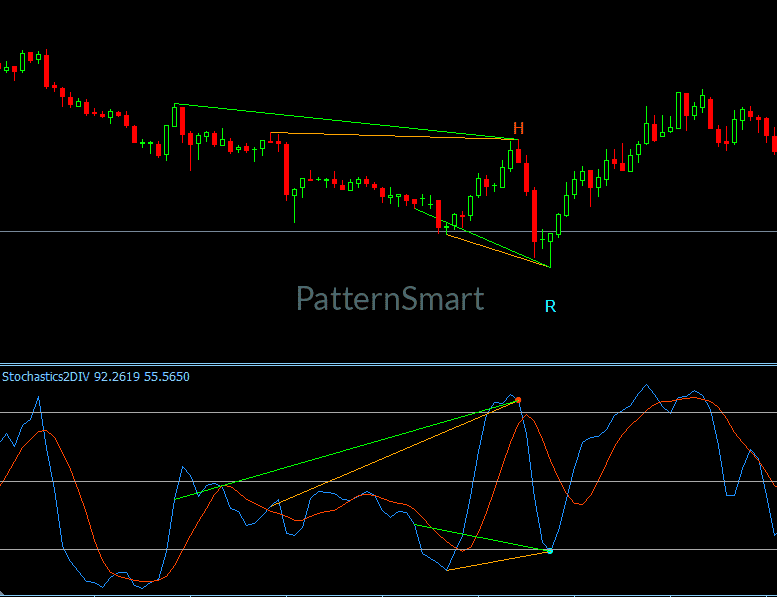
Why Use Stochastics for Double Divergence Analysis?
Different indicators measure different characteristics of market behavior. Stochastics focuses on market positioning within a recent trading range, giving traders a perspective that is different from indicators designed primarily around trend strength, capital flow, or volatility.
The Stochastics Double Divergence approach focuses on four closely related concepts:
- Short-term momentum
- Reversal timing
- Relative market positioning
- Oscillator behavior
Because Stochastics is relatively responsive, it can be useful when evaluating short-term changes in momentum. Divergence frequently develops near temporary market extremes, where price continues to move but oscillator behavior begins to change.
This makes Stochastics Double Divergence particularly relevant to:
- Range-bound markets
- Swing trading
- Short-term trends
- Reversal environments
- Active chart analysis
The indicator is designed for analytical use rather than as an automatic trading system. Its signals should be evaluated together with price action, market structure, support and resistance, and other relevant evidence.
Understand the Four Double Divergence Signal Types
Stochastics Double Divergence Pro supports the four official divergence classifications used throughout the PatternSmart product family:
Bullish Regular Divergence
Bullish Regular Divergence occurs when price forms a lower low while the indicator forms a higher low.
This can indicate that downside price movement is no longer being fully confirmed by the underlying indicator behavior. In a broader market context, this may provide information when evaluating potential changes in short-term momentum.
Bearish Regular Divergence
Bearish Regular Divergence occurs when price forms a higher high while the indicator forms a lower high.
The price movement is extending upward while the indicator fails to confirm the new extreme. This can provide additional information when evaluating weakening short-term momentum and potential reversal conditions.
Bullish Hidden Divergence
Bullish Hidden Divergence occurs when price forms a higher low while the indicator forms a lower low.
This type of divergence is commonly associated with pullbacks within an established upward market structure and can contribute to continuation analysis.
Bearish Hidden Divergence
Bearish Hidden Divergence occurs when price forms a lower high while the indicator forms a higher high.
This can provide additional information when evaluating pullbacks within a broader downward market structure.
Regular and Hidden Divergence represent different types of analytical information. Neither should be treated as inherently superior; their significance depends on market context and confirmation.
Stochastics Double Divergence and Reversal Timing
One of the most useful applications of Stochastics Double Divergence is the study of short-term reversal timing.
A market can continue moving in one direction even after short-term momentum begins to change. This creates a potential analytical gap between what price is doing and what the oscillator is showing.
For example, imagine price makes a new low during a decline while Stochastics establishes a higher low. The price chart is still showing weakness, but the oscillator is no longer confirming the same degree of downside momentum.
That observation does not mean that a reversal must occur.
Instead, it raises an analytical question:
Is the current price movement still supported by the same short-term momentum?
That question is central to the PatternSmart approach.
Additional confirmation can then come from:
- Price structure
- Support and resistance
- Candlestick behavior
- Higher-timeframe context
- Other momentum or trend information
The purpose is to build a broader body of evidence rather than react to divergence in isolation.
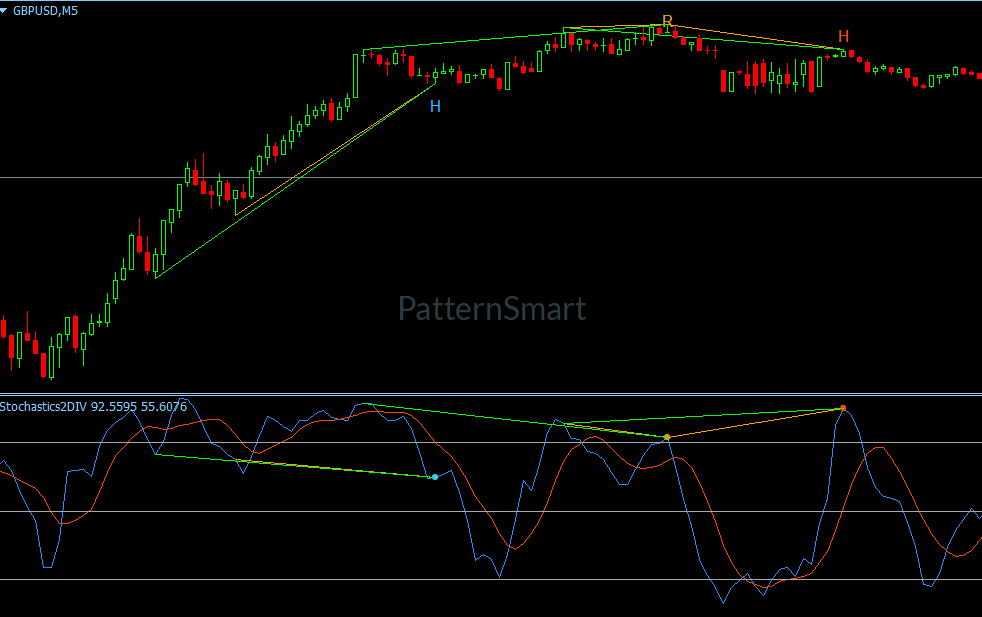
Double Divergence Is About Confirmation, Not Prediction
A divergence observation does not guarantee a reversal.
Markets can remain overextended for longer than expected, and oscillators can produce multiple divergence observations during a strong directional movement. This is particularly relevant to Stochastics because its responsiveness can also result in more frequent signals.
The PatternSmart methodology therefore emphasizes confirmation over prediction.
A useful analytical workflow is:
- Identify the divergence classification.
- Understand what Stochastics is measuring.
- Examine the surrounding price structure.
- Evaluate the broader market context.
- Seek additional confirmation.
- Interpret the evidence as a whole.
- Make an independent trading decision.
This confirmation-first philosophy helps prevent divergence from becoming a standalone entry or exit rule.
Stochastics Double Divergence Pro Features for MT5
Stochastics Double Divergence Pro includes configurable features designed to help traders organize signal generation, filtering, alerts, and chart presentation.
Select the Divergence Types You Want to Analyze
The indicator provides separate controls for:
- Show Regular Bullish
- Show Regular Bearish
- Show Hidden Bullish
- Show Hidden Bearish
This allows the chart to focus on the divergence classifications relevant to the trader’s analytical workflow.
All four are enabled by default according to the official Pro Inputs Manual.
Wait 1 Bar
Wait 1 Bar controls whether one completed confirmation bar is required before a detected Double Divergence signal is finalized.
When enabled, the indicator waits until the next bar has completely closed before confirming the signal. This can provide additional confirmation and reduce premature signal confirmation, although confirmation occurs later.
When disabled, signals can be confirmed immediately after the internal divergence conditions have been satisfied.
Importantly, this setting changes when a signal becomes visible, not how divergence itself is detected.
Enhanced Mode
Enhanced Mode is a Signal Filtering feature that applies additional structural filtering.
It is designed as a quality-control mechanism rather than a separate trading strategy. The default setting is False.
Divergence Bar Range
Divergence Bar Range controls the divergence swing distance.
This parameter belongs to the indicator’s advanced configuration and can influence how divergence structures are evaluated. Its default value is ShortRange.
Divergence Lookback
Divergence Lookback controls swing point detection.
The default value is 5. This setting belongs to the Advanced Parameters category and contributes to the internal analytical process used to evaluate divergence structures.
Filter Length
Filter Length controls smoothing and structural filtering.
Its default value is 5. As with the other advanced parameters, it should be understood as a configuration option rather than an independent trading strategy.
Keep MT5 Charts Organized
Active traders can quickly accumulate multiple historical divergence observations on a chart. Stochastics can also produce frequent signals because it is a relatively responsive oscillator.
PatternSmart therefore provides visualization controls including:
- Show Char
- Show Line
- Only Show Last Signal Within Bars
- Price Line Brush
- Price Line Dash Style
- Price Line Width
Only Show Last Signal Within Bars is specifically designed to reduce chart clutter by removing older nearby signals. Its default value is 10.
These visualization features affect presentation rather than changing the underlying Double Divergence methodology.
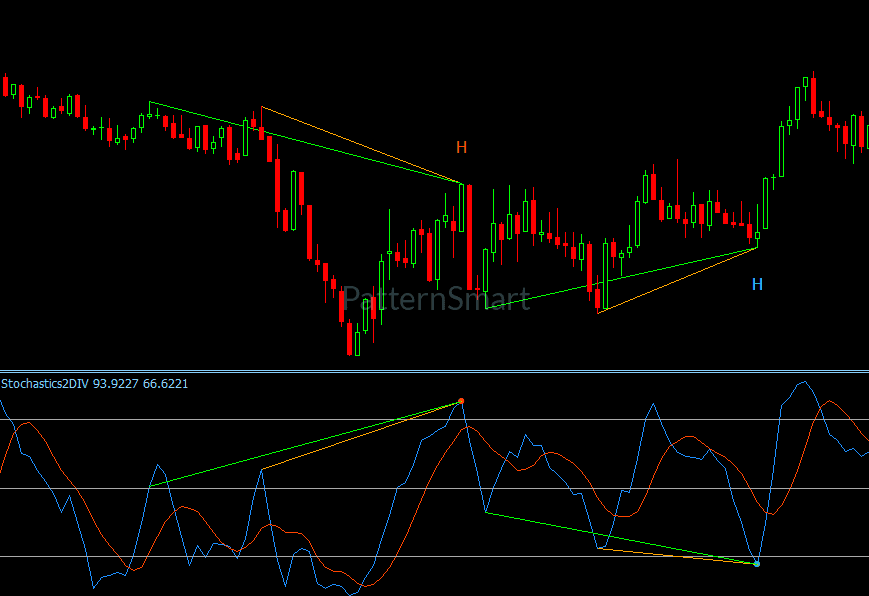
Real-Time Alerts for Confirmed Divergence
The indicator also includes:
- Enable Alert
- Alert Sound
According to the Pro Inputs Manual, Enable Alert is enabled by default, while Alert Sound uses Alert1.wav as its default sound.
Alert features are designed to communicate confirmed signals and improve workflow efficiency. They do not change the underlying signal calculation.
Stochastics Double Divergence Pro on MetaTrader 5
MetaTrader 5 provides a modern, multi-asset trading environment designed for traders working across different financial markets. Its typical users include Forex, CFD, stock, futures, commodity, and cryptocurrency traders.
Its platform characteristics include:
- Multi-asset support
- Expanded analytical capabilities
- Flexible workflow
- Modern charting environment
- Scalable market analysis
Stochastics Double Divergence Pro fits naturally into this environment by providing a consistent divergence-analysis framework that can be applied across different market types while preserving the same PatternSmart methodology.
The platform changes the trading workflow and implementation—not the underlying Double Divergence analytical principles.
Multi-Market Short-Term Momentum Analysis
Because MT5 supports multiple asset classes, traders can use the same analytical framework when studying different markets.
Potential applications include:
- Forex momentum analysis
- Stock chart analysis
- Futures market analysis
- Commodity analysis
- Cryptocurrency analysis
- CFD analysis
However, the meaning and frequency of divergence can vary substantially between markets and timeframes.
A Stochastics divergence observed in a quiet range should not automatically be interpreted in the same way as one developing during a strong directional market.
This is why context remains essential.
The indicator provides the observation. The trader evaluates what that observation means within the current market environment.
[Get Started With Double Divergence Pro for MT5]
Looking for the complete mathematical breakdown, step-by-step optimization guides, and advanced trading strategies? Explore our comprehensive documentation:
Visit the Technical Inputs Manual: Double Divergence Pro for full parameter tuning.
Read the master guide on the Double Divergence Indicator Series.
Why Stochastics Double Divergence Can Be Useful for Active Traders
Stochastics Double Divergence has several characteristics that make it relevant to active technical analysis.
Short-Term Momentum Perspective
Stochastics focuses on relative positioning within a recent trading range, providing a short-term view of momentum behavior.
Reversal Analysis
Divergence around temporary market extremes can provide additional information when evaluating possible changes in short-term momentum.
Continuation Analysis
Hidden divergence provides a framework for examining pullbacks and potential continuation within an established market structure.
Flexible Signal Selection
Separate controls for the four divergence classifications allow traders to configure the information displayed according to their analytical workflow.
Structured Confirmation
The methodology encourages traders to combine divergence with price action and broader market context instead of treating an oscillator signal as a standalone decision rule.
Customizable Chart Presentation
Display and visualization controls help traders manage how divergence information appears on MT5 charts.
These benefits reflect the intended analytical role of the indicator rather than any guarantee of trading performance.
Stochastics Double Divergence vs. Traditional Stochastics
Traditional Stochastics analysis can provide useful information about momentum and relative price positioning.
Stochastics Double Divergence adds a structured way to compare Stochastics behavior against price movement.
The distinction is important:
Traditional Stochastics
- Studies oscillator behavior
- Evaluates relative price positioning
- Can contribute to momentum analysis
Stochastics Double Divergence
- Compares price behavior with Stochastics behavior
- Identifies Regular and Hidden Divergence classifications
- Provides both bullish and bearish divergence analysis
- Supports structured confirmation
- Integrates divergence observations into a broader analytical framework
The goal is not to replace conventional Stochastics analysis. It is to provide another way of interpreting the relationship between price and short-term oscillator behavior.
Who Is Stochastics Double Divergence Pro for MT5 Designed For?
The indicator is particularly relevant to traders interested in:
- Short-term momentum analysis
- Swing trading
- Active discretionary trading
- Reversal analysis
- Oscillator-based technical analysis
- Multi-market chart analysis
- Divergence confirmation
Stochastics is relatively sensitive compared with slower oscillators. That responsiveness can be valuable for short-term analysis, but it can also result in more frequent observations. For that reason, confirmation and market context remain important.
A Practical Framework for Using Stochastics Double Divergence
Rather than asking whether a divergence signal should automatically result in a trade, consider using it as part of a structured analytical process.
Step 1: Observe Price
Start with the price chart. Identify the current trend, range, swing structure, and important technical levels.
Step 2: Examine Stochastics
Look at how Stochastics is behaving relative to the recent trading range.
Step 3: Identify the Divergence Type
Determine whether the observation is:
- Bullish Regular Divergence
- Bearish Regular Divergence
- Bullish Hidden Divergence
- Bearish Hidden Divergence
Step 4: Evaluate Context
Ask whether the divergence is occurring during a range, pullback, established trend, or potential market extreme.
Step 5: Seek Confirmation
Consider price action, market structure, support and resistance, and other relevant technical evidence.
Step 6: Interpret Rather Than Predict
Use the divergence as additional information about current market behavior rather than as a guaranteed forecast.
This process reflects the broader PatternSmart principle of Observe → Compare → Confirm → Interpret → Evaluate.
Frequently Asked Questions
What is Stochastics Double Divergence?
Stochastics Double Divergence compares price movement with Stochastics behavior to identify situations where short-term momentum and price movement are no longer developing in complete agreement.
What does Stochastics measure?
Stochastics measures market positioning within a recent trading range. This makes it particularly useful for evaluating short-term momentum and oscillator behavior.
What types of divergence does the indicator identify?
Stochastics Double Divergence Pro supports Bullish Regular Divergence, Bearish Regular Divergence, Bullish Hidden Divergence, and Bearish Hidden Divergence.
Can Stochastics Double Divergence identify reversals?
It can provide additional analytical information when evaluating potential reversals, particularly around temporary market extremes. However, divergence does not guarantee that a reversal will occur. Confirmation and broader market context remain important.
Can it be used for trend continuation analysis?
Yes. Hidden Divergence is commonly associated with pullbacks and continuation analysis, although its significance depends on market structure and confirmation.
Is Stochastics Double Divergence suitable for swing trading?
The Indicator Knowledge Base specifically identifies swing trading as one of the suitable trading styles for Stochastics Double Divergence.
Does the indicator work with different markets on MT5?
MT5 supports a broad multi-asset environment including Forex, stocks, futures, CFDs, commodities, and cryptocurrencies. The Double Divergence methodology remains consistent across markets, although market context and signal behavior can vary.
Can I display only certain divergence types?
Yes. Separate settings are provided for Show Regular Bullish, Show Regular Bearish, Show Hidden Bullish, and Show Hidden Bearish.
Does the indicator provide alerts?
Yes. The product includes Enable Alert and Alert Sound settings.
Does divergence guarantee a profitable trade?
No. PatternSmart’s methodology treats divergence as analytical evidence rather than a prediction or guarantee. Confirmation strengthens analytical confidence but does not eliminate market uncertainty.
Conclusion
Stochastics Double Divergence Pro for MT5 is designed for traders who want a structured way to study the relationship between price action and short-term oscillator momentum.
Stochastics provides a perspective on relative market positioning within a recent trading range. Double Divergence adds a confirmation-oriented framework for evaluating when price and oscillator behavior begin communicating different information.
For active traders, swing traders, and technical analysts, this can provide another layer of evidence when studying:
- Short-term momentum changes
- Potential reversal environments
- Temporary market extremes
- Pullbacks and continuation
- Divergence confirmation
- Multi-market technical analysis
The underlying principle remains straightforward: observe price, compare indicator behavior, evaluate context, seek confirmation, and interpret the complete body of evidence.
Stochastics Double Divergence Pro for MT5 is built to support that analytical process within the flexible, multi-asset environment of MetaTrader 5.
Explore Stochastics Double Divergence Pro for MT5 and add structured Stochastics divergence analysis to your MetaTrader 5 technical analysis workflow.