While the standard Evening Star pattern is an incredibly powerful bearish reversal signal, its high-conviction variant—the Evening Doji Star—represents the absolute pinnacle of structural market exhaustion.
When a standard uptrend begins to roll over, a small-bodied candle on Day 2 signals a minor slowdown. However, when that second candle collapses into a pure Doji, it means that despite extreme effort, buyers could not tick the market even a fraction of a percent higher by the closing bell. It represents a total psychological stalemate at the absolute top of a macro expansion, setting the stage for a violent institutional reversal.
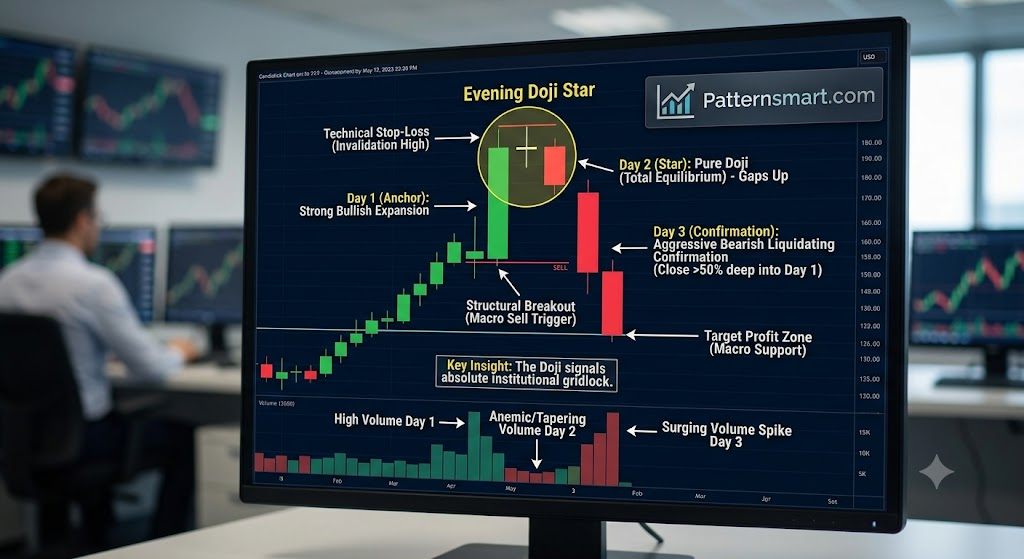
Anatomy of the Evening Doji Star
To distinguish a textbook Evening Doji Star from a standard three-candle reversal pattern, it must adhere to a strict structural blueprint:
- Trend Context: The pattern must print at the peak of a mature, well-defined uptrend or at an established macro psychological resistance level.
- Candle 1 (Bullish Expansion): A long, strong bullish (green or white) candle that represents the final, aggressive push of the prevailing trend.
- Candle 2 (The Doji Star):
- The price gaps up above the closing real body of Candle 1.
- The candle must be a Doji—meaning the opening and closing prices are virtually identical, leaving a tiny or non-existent real body with upper and lower shadows.
- Candle 3 (Bearish Liquidating Confirmation): A large, impulsive bearish (red or black) candle that drives down forcefully, closing at least 50% or deeper into the real body of Candle 1.
Evening Doji Star vs. Standard Evening Star
The core difference lies entirely within the psychological friction of the second session:
| Pattern | Day 2 Candle Type | Level of Intraday Friction | Reversal Conviction |
| Standard Evening Star | Small Real Body (Spinning Top) | Minor slowing of momentum. | High |
| Evening Doji Star | Pure Doji (Open = Close) | Absolute, complete equilibrium between bulls and bears. | Extremely High |
Market Psychology: The Ultimate Gridlock
The Evening Doji Star tells a highly dramatic story of a trend running headfirst into a massive wall of institutional supply.
- The Final Surge (Day 1): The bulls are completely confident. They drive the asset up to local highs, creating a wide-range bullish expansion candle.
- The Structural Gridlock (Day 2): The market opens with an aggressive gap up, catching the final wave of retail FOMO buyers. However, institutional distribution begins immediately at these rich valuations. The bulls try to push higher; the bears swat it back down. By the closing bell, the price lands exactly where it opened. This Doji signals that despite heavy volume and broad participation, the bulls have completely lost their capacity to advance.
- The Trap Snaps (Day 3): Realizing the top is in, the bulls immediately stop bidding. Institutional short-sellers step on the gas, driving a massive red candle deep into the positions established on Day 1. Long traders panic and liquidate, causing a self-fulfilling downward spiral.
How to Trade the Evening Doji Star
Because a Doji implies complete indecision, trading the Doji itself is highly dangerous. You must trade the completed structure once the market confirms its direction.
1. Execution Triggers
- The Aggressive Close: Enter a short position in the final minutes of Day 3’s session, provided the real body has decisively breached the 50% midpoint of Day 1’s real body.
- The Structural Breakout: Place a sell-stop order just below the absolute low of the Day 1 bullish candle. Entering here ensures you are riding the macro momentum as the entire week’s structural floor collapses.
2. Risk Management Parameters
- Stop-Loss: Place your technical stop-loss just above the highest wick of the Day 2 Doji. Because a Doji represents a major structural ceiling, an invalidation of this high means a massive supply block has been completely absorbed by buyers, nullifying the short setup.
- Take-Profit: Target key historical demand zones, local support levels, or trailing extensions using key moving averages to maximize your risk-to-reward ratio.
Volume Confluence Validation: Pay close attention to the volume signature across this three-day arc. A flawless Evening Doji Star features high volume on Day 1, anemic or tapering volume on the Day 2 Doji (indicating buyers are totally drying up), and a massive volume expansion spike on Day 3 as institutions funding the shift aggressively commit capital to the short side.
Please check our Bearish and Bullish Patterns Indicator collection.